Can a Wellness Smart Home System Be Added to an Existing Luxury Home?
One of the most common questions we hear from Brentwood and Malibu homeowners is whether a wellness smart home retrofit existing home project is actually feasible, or whether you need to build from the ground up to enjoy the full benefits. The short answer is yes, you can retrofit most wellness technology into an existing luxury home, and many systems require no construction at all. This guide walks you through exactly which systems can be added today, which ones benefit from a bit more planning, and how to sequence your project intelligently.
Step 1: Understand What a Wellness Smart Home Retrofit Involves
A wellness smart home retrofit in an existing home means layering health-focused technology onto a residence that was not originally designed with these systems in mind. Unlike a ground-up build where conduit pathways, pre-wiring, and mechanical infrastructure are planned from the start, a retrofit requires an honest assessment of what your home already has, and what gaps need to be filled.
For most luxury homes in Los Angeles built in the last 20 years, the infrastructure is surprisingly capable. High-end residences in Brentwood and Malibu typically have robust electrical panels, modern HVAC equipment, and in many cases, existing CAT6 or coaxial cabling that can be repurposed. Your starting point determines your speed and budget.
The retrofit process generally falls into three categories:
- Drop-in wireless systems: no construction, installed in hours or days
- Hybrid systems: wireless control layer added to existing mechanical infrastructure
- Infrastructure-dependent systems: require some wall access, electrical work, or HVAC modification
Understanding which category each wellness system falls into allows you to phase your project intelligently and prioritize the upgrades that deliver the most impact with the least disruption.
Step 2: Start with No-Construction Wellness Upgrades
These systems are the ideal entry point for any wellness smart home retrofit in an existing home because they can be deployed without opening a single wall. They deliver measurable health benefits immediately and integrate with broader platforms like Control4, Crestron, or Lutron as your system grows.
Wireless Air Quality Monitoring
Devices like Airthings View Plus or Awair Element monitor particulate matter (PM2.5), CO2, VOCs, humidity, and radon levels in real time. They connect via Wi-Fi or Zigbee and display data through smartphone apps or integrate directly into your smart home dashboard. For Malibu homeowners near wildfire corridors, real-time particulate monitoring is particularly valuable during Santa Ana wind events.
Circadian Lighting Control
Lutron Caseta and the Ra2 Select line allow wireless dimmer replacements that require no new wiring, just swapping existing switches. Paired with tunable LED bulbs from manufacturers like Ketra, these systems automatically shift color temperature throughout the day to support your body's natural sleep-wake rhythms. A bedroom that transitions from bright, cool white at 7 a.m. to warm amber by 9 p.m. measurably reduces blue light exposure in the hours before sleep.
Motorized Shades
Battery-operated motorized shades from Lutron Serena or Hunter Douglas PowerView require no hardwiring and can be installed on any window in an afternoon. Programmed to open with sunrise and close during peak afternoon sun, they regulate natural light exposure and reduce solar heat gain: a significant factor in Malibu properties with large west-facing glass walls.
Step 3: Add Hybrid Wellness Systems That Work With Existing Infrastructure
Once your no-construction layer is in place, the next phase of a wellness smart home retrofit for your existing home involves connecting to mechanical systems that are already installed but not yet smart-enabled.
HVAC and Air Purification Integration
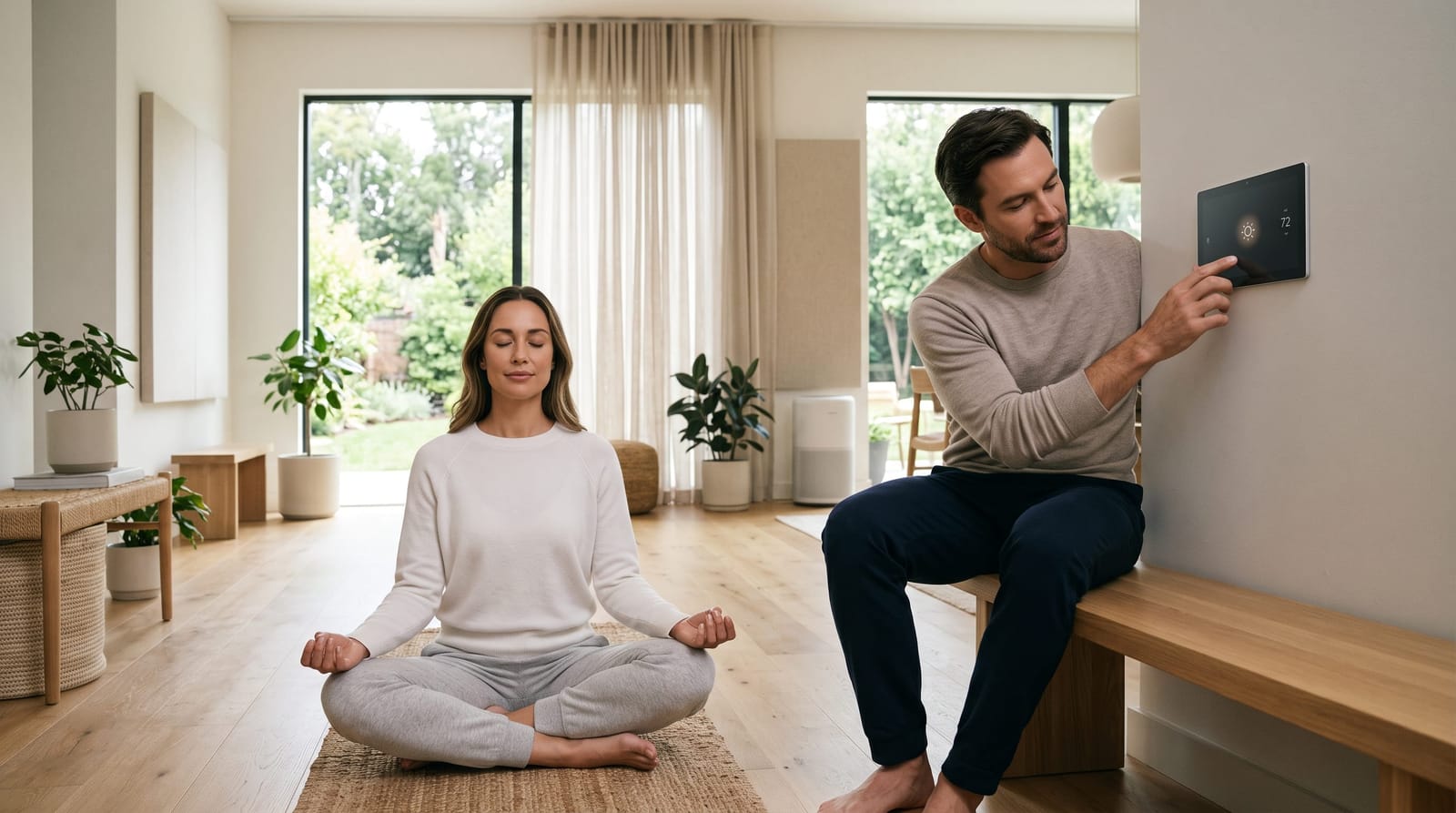
Most modern forced-air systems can accept a smart thermostat upgrade (Ecobee, Nest, or a professionally integrated Honeywell system) with minimal wiring changes. More significantly, whole-home air purification can often be added inline to existing ductwork. HEPA filtration modules and UV-C germicidal systems from brands like RGF or Apco-X are designed for duct installation and do not require replacing your air handler. For homes with existing Crestron or Control4 automation, these systems can be monitored and controlled from the same interface as your lighting and shading.
Circadian and Wellness Lighting Expansion
If your home has existing low-voltage lighting infrastructure or a Lutron homeworks system already installed, expanding to full-spectrum tunable lighting across all living areas is often a firmware update and fixture swap, not a rewire. Many Brentwood estates built in the 2010s already have Lutron backbone systems that simply need to be upgraded to support tunable white or RGBW fixtures.
Step 4: Plan for Infrastructure-Dependent Wellness Systems
Some wellness technologies deliver their full benefit only when integrated during a renovation or carefully coordinated wall-access project. These are worth planning even if you are not doing a full remodel: many can be executed during routine maintenance windows or alongside other cosmetic work.
Dedicated Outdoor Air Systems (DOAS)
True whole-home fresh air ventilation, where filtered outdoor air is mechanically introduced into every room at controlled rates, typically requires new ductwork and an energy recovery ventilator (ERV) or heat recovery ventilator (HRV). This is the gold standard for indoor air quality but represents a meaningful infrastructure project. If you are planning a kitchen or bathroom renovation, this is the ideal moment to rough in the ductwork.
In-Wall Wiring for Biometric and Wellness Devices
Dedicated wellness spaces, meditation rooms, home gyms, or sleep sanctuaries, benefit from pre-wired low-voltage pathways for biometric sensors, EMF-shielded panels, and structured wiring for audio and lighting control. If a room refresh is already planned, investing in pre-wire during that window eliminates future disruption entirely.
For a realistic picture of what these phased upgrades represent financially, reviewing wellness smart home system cost Los Angeles gives homeowners a clear framework before committing to scope.
Step 5: Choose the Right Integration Partner for Your Retrofit
A wellness smart home retrofit in an existing luxury home is only as good as the integration behind it. Individual devices that do not communicate with each other create fragmented experiences: you end up managing five apps instead of one unified environment. An experienced smart home integrator will audit your existing infrastructure, identify what can be repurposed, and design a system architecture where air quality data triggers HVAC responses, sunrise schedules coordinate lighting and shading simultaneously, and the entire environment is controllable from a single interface.
In Los Angeles, the most successful retrofit projects begin with a thorough site assessment, not a product pitch. The right partner asks about your daily routines, your sleep concerns, your sensitivity to air quality during fire season, and your long-term renovation plans before recommending a single device.
Frequently Asked Questions
How disruptive is a wellness smart home retrofit in an existing home?
For wireless and drop-in systems, disruption is minimal: most installations are completed in one to three days with no drywall work. Hybrid systems connecting to existing HVAC or electrical may require a licensed electrician for a day or two. Infrastructure-dependent systems like dedicated ventilation require a more substantial mechanical project, which is best timed alongside other renovation work.
Which wellness upgrade delivers the most immediate benefit in an existing home?
Air quality monitoring combined with upgraded filtration consistently delivers the most noticeable and measurable impact. Homeowners are often surprised to discover elevated CO2 or VOC levels in well-sealed, energy-efficient homes. Addressing air quality directly affects sleep quality, cognitive clarity, and overall comfort, and both the monitoring and filtration upgrades can be completed without any construction.
Can existing Lutron or Crestron systems be upgraded for wellness without replacing everything?
In most cases, yes. Existing Lutron HomeWorks QS systems can be expanded with Ketra tunable lighting modules through a software and hardware upgrade rather than a full replacement. Crestron platforms are similarly extensible. A qualified integrator can assess your current system version and determine the upgrade path that preserves your existing investment.
Is a wellness smart home retrofit worth it for a home I plan to sell in a few years?
Wellness features, particularly whole-home air quality systems, circadian lighting, and integrated shading, are increasingly listed as premium amenities in the Brentwood and Malibu luxury market. While individual circumstances vary and we recommend consulting with a real estate professional for guidance specific to your situation, wellness-focused smart home integration is widely recognized as a differentiating feature in the $3M+ segment.
Conclusion
A wellness smart home retrofit for an existing luxury home is not only possible, for most Los Angeles properties, it is highly practical. The key is sequencing: start with wireless air quality, lighting, and shading systems that require no construction, layer in hybrid HVAC and filtration upgrades, and plan infrastructure-dependent systems around natural renovation windows. With the right integration partner, your existing home can become a fully realized wellness environment without the cost or disruption of rebuilding from scratch. This is one piece of a much larger conversation about what modern wellness smart home systems can deliver for discerning homeowners.