Can You Add Lighting Control to an Existing Home Without Rewiring?

One of the most common questions we hear from Los Angeles homeowners is this: "I love the idea of a luxury lighting control system, but my home is already finished. Does that mean I'm looking at walls torn open and months of construction?" The short answer is no, and the longer answer is even better. Wireless lighting control for an existing home has advanced dramatically, making sophisticated automation accessible without a single drywall patch. This post walks through your real options, what each one delivers, and where the technology genuinely shines.
Option 1: Wireless Smart Switches and Dimmers (The Most Seamless Retrofit)
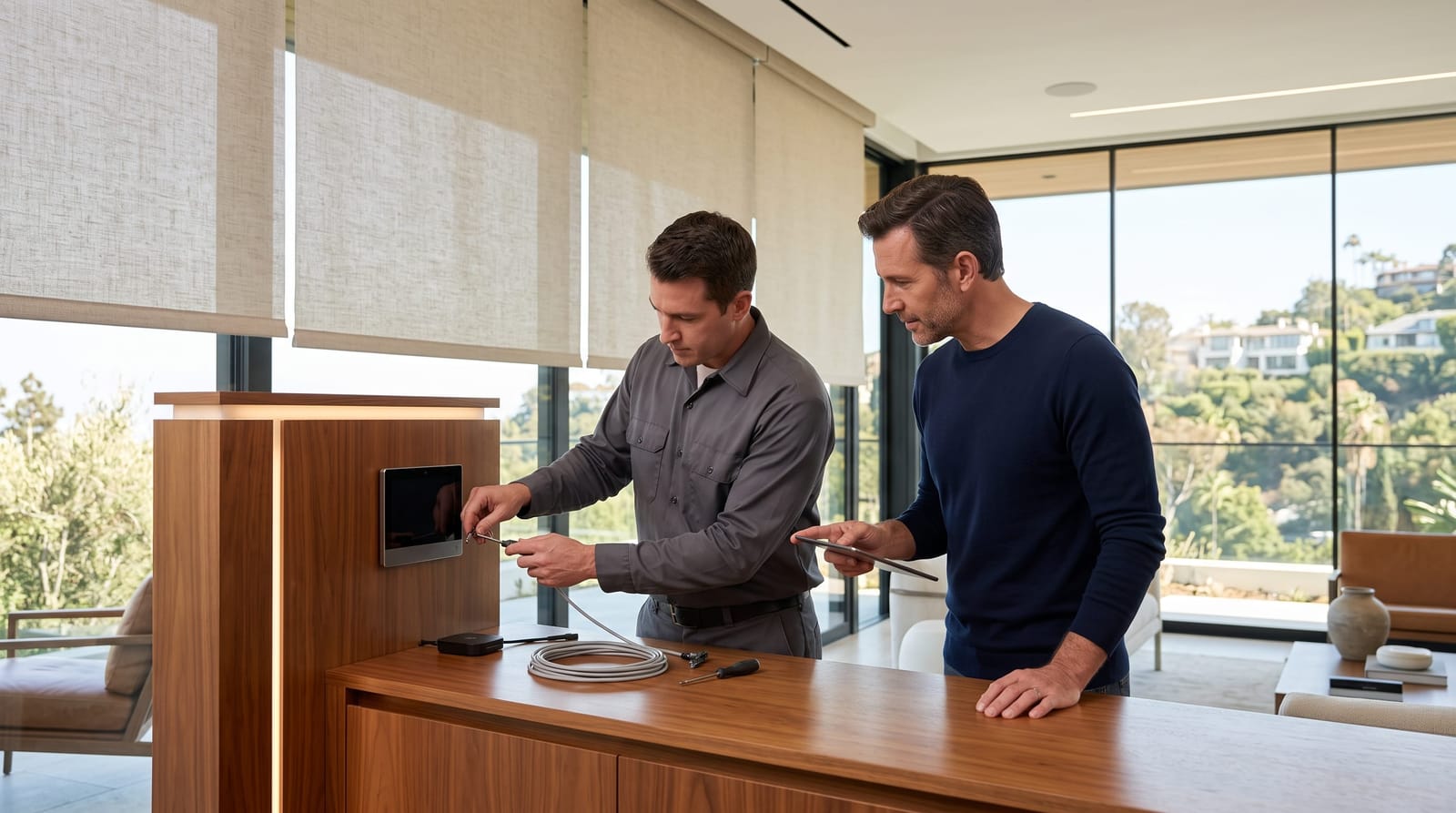
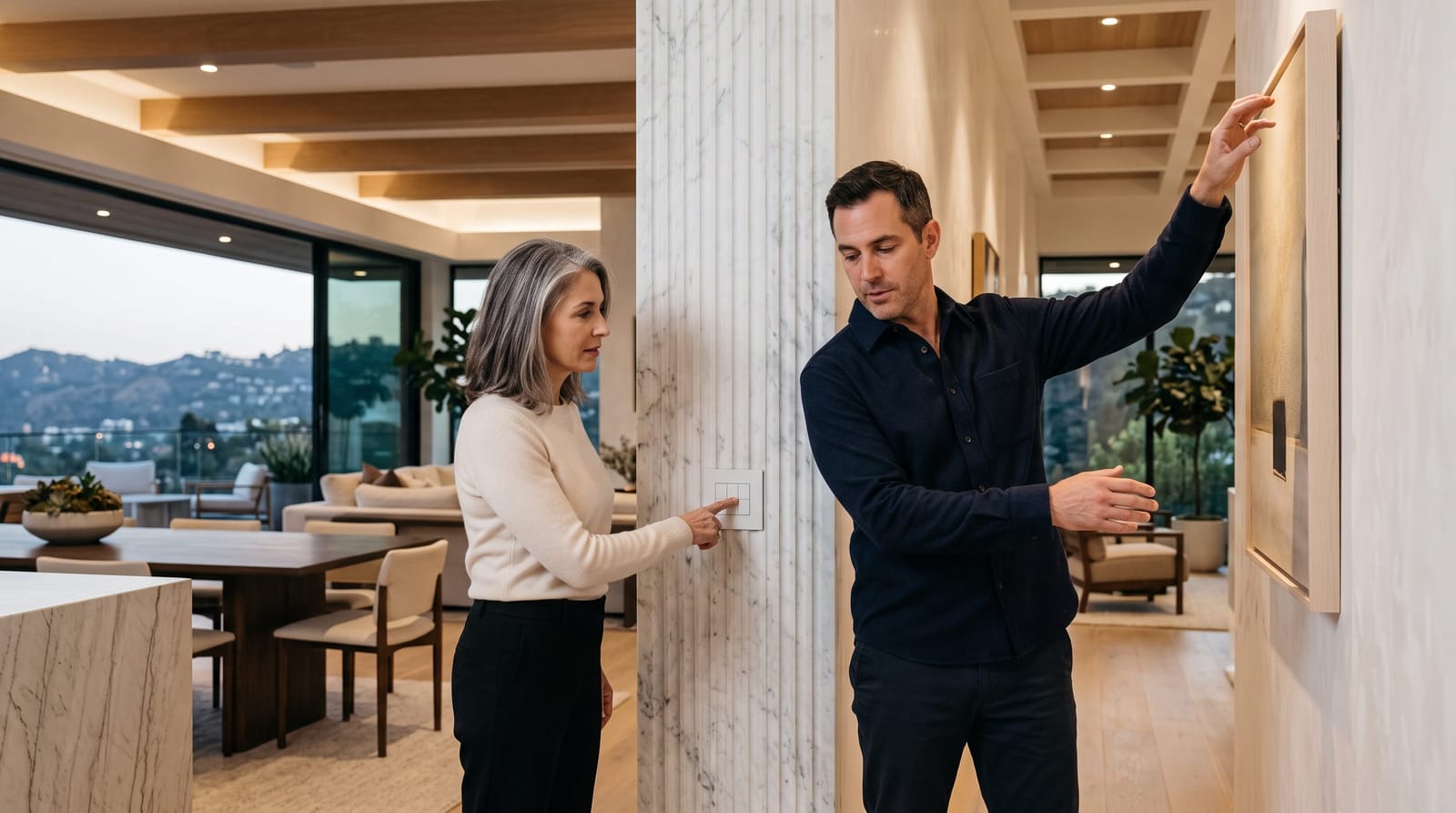
For most finished luxury homes, wireless smart switches and dimmers are the gold-standard retrofit solution. Products like the Lutron Caséta and Lutron RA2 Select systems replace your existing wall switches with smart dimmers that communicate wirelessly with a central hub: no new wiring runs required. Electricians typically swap out a standard switch in under 30 minutes per location.
What makes Lutron particularly well-suited to high-end residential work is its reliability. Lutron's Clear Connect RF technology operates on a dedicated 434 MHz frequency, meaning it doesn't compete with your Wi-Fi network, Bluetooth devices, or the dozens of other wireless signals in a modern home. Independent testing has shown Clear Connect achieves a 99.9% wireless reliability rate: a figure that matters enormously when you're trying to build a whole-home lighting experience, not just automate a single lamp.
Lutron Caséta is ideal for homes with straightforward dimming needs and up to around 75 devices. For larger estates or more complex scene programming, Lutron RA2 Select scales to handle up to 100 devices per system with expanded keypad and occupancy sensor support. Both integrate with Apple HomeKit, Amazon Alexa, Google Home, and most professional control systems like Savant and Control4.
One important technical note: wireless smart switches do still require a neutral wire in most cases, or a compatible no-neutral configuration. A licensed electrician should assess each switch location before installation begins.
Option 2: Smart Bulb Ecosystems (Flexible but Limited)
Smart bulb systems, Philips Hue being the most recognized, offer genuine zero-rewiring installation. You screw in a bulb, connect to a hub or directly to your Wi-Fi, and you're controlling color, brightness, and color temperature from your phone within minutes. Philips Hue's ecosystem now spans over 400 products, from standard A19 bulbs to recessed downlights and exterior fixtures, which speaks to how mature this category has become.
For circadian rhythm lighting specifically, smart bulbs with tunable white capability (adjustable color temperature from warm amber to cool daylight) can be programmed to shift throughout the day, warmer tones in the evening to support melatonin production, cooler tones in the morning to encourage alertness. This is a genuine wellness benefit, not a marketing claim, and it's available in a retrofit context without touching your wiring.
The limitations matter, though. Smart bulbs depend on the physical switch remaining in the "on" position at all times: anyone who flips the wall switch off cuts power and defeats the automation entirely. In a luxury home where consistency and elegance matter, this creates real friction. Smart bulb systems also top out in sophistication; they rarely integrate at the same depth with whole-home automation platforms that architects and interior designers specify for high-end projects. Think of smart bulbs as an excellent entry point or supplement, not a complete luxury lighting control solution.
Option 3: Wireless Battery-Free and Energy-Harvesting Controls (Emerging and Worth Knowing)
A newer category that's gaining traction in retrofit and commercial renovation projects involves kinetic or energy-harvesting wireless switches: devices that generate the power needed to transmit a wireless signal from the physical act of pressing the switch itself. No batteries. No wiring. No wall penetration beyond mounting hardware.
Companies like EnOcean have pioneered this technology, and it's beginning to appear in residential applications, particularly in heritage buildings, rental properties, or any space where adding wiring or replacing batteries is impractical. For a finished luxury home with unusually complex wall construction, think plaster walls, historic details, or concrete, this option deserves a conversation with your lighting integrator.
The trade-off today is ecosystem depth. Battery-free wireless switches currently offer more limited integration with advanced scene control and circadian automation platforms than Lutron-based systems. This is an area to revisit annually as the technology matures quickly.
Option 4: Hybrid Approaches for Larger Properties
Many Los Angeles homes that look "finished" actually present some accessible pathways: attic runs, garage adjacencies, or interior walls that a skilled low-voltage installer can use to introduce a small amount of new wiring without visible disruption. This opens the door to a hybrid approach: wireless control where wiring access is impossible, and hardwired control where a clean run is achievable.
For properties over 5,000 square feet, or homes where the lighting design includes extensive outdoor zones, motorized shading, and HVAC integration alongside lighting, a hybrid system typically delivers the most reliable and architecturally cohesive result. Systems like Lutron RadioRA 3 are explicitly designed for this scenario, supporting both wired and wireless devices within a single integrated platform handling up to 200 devices per system.
If you're also exploring ways to remove light switches from walls entirely for a cleaner aesthetic, a hybrid system gives your integrator the flexibility to place keypads and touchscreens exactly where the design calls for them, not just where existing boxes happen to be.
Where Wireless Lighting Control Works Best in Existing Homes
Based on project experience, wireless lighting control for an existing home is highly feasible, and often the preferred approach, in the following scenarios:
- Single-story homes or condominiums with accessible electrical boxes
- Homes with relatively recent wiring (post-1990) where neutral wires are present at most switch locations
- Properties where construction disruption would affect finished wood floors, custom millwork, or irreplaceable materials
- Rental properties or secondary residences where the owner needs automation without major capital investment
- Phased projects where the homeowner wants to start with one floor or zone and expand over time
Where wireless retrofit becomes more complex: very old wiring without neutral conductors throughout, homes with aluminum wiring (which requires specific compatible devices), or properties where the existing fixture and switch count is unusually high and requires a larger professional system from the outset.
Frequently Asked Questions
Will wireless lighting control work with my existing light fixtures and bulbs?
In most cases, yes. Wireless smart dimmers like Lutron Caséta work with a wide range of existing LED, incandescent, and halogen fixtures. However, not all LED bulbs are dimmer-compatible, and some may flicker or buzz if they're not on a tested compatibility list. Lutron publishes a lamp compatibility database with over 10,000 tested products. An integrator should audit your current fixtures before the system is specified.
How long does a wireless lighting retrofit typically take?
For a moderately sized home, 10 to 20 switch locations, a professional wireless lighting control installation typically takes one to two days of on-site work. Larger estates with 30 or more devices and integration with shading or AV systems may take three to five days. Unlike a hardwired system that might require weeks of construction access, wireless retrofits are notably faster and less disruptive.
Can I control my lighting remotely when I'm away from home?
Yes. Both Lutron Caséta and Lutron RA2 Select offer cloud-connected remote access through their smartphone apps, provided the hub is connected to your home network. This allows you to adjust scenes, set schedules, and check the status of individual fixtures from anywhere. Many homeowners use this for security lighting schedules and energy management when traveling.
Is professional installation necessary, or can I do this myself?
Some wireless smart bulb products are genuinely DIY-friendly. However, replacing wall switches, even wireless ones, involves working inside your electrical panel's circuit, which carries safety considerations. Most jurisdictions require a licensed electrician to perform switch replacements. For a luxury-grade system with scene programming, keypad engraving, and whole-home integration, professional installation by a certified Lutron dealer is the appropriate path. Always consult a licensed electrician for any work inside your electrical system.
The Bottom Line
Wireless lighting control for an existing home is not a compromise, for the right property, it's the most intelligent and least disruptive path to a true luxury lighting experience. Lutron-based wireless systems in particular deliver professional-grade reliability, deep integration with whole-home automation, and the circadian and scene-based capabilities that define high-end residential lighting design. If you've been delaying a lighting upgrade because you assumed it required major construction, that assumption is worth revisiting. The technology has moved well past that limitation, and a consultation is the fastest way to see what's genuinely possible in your specific home.