How Smart Home Automation Supports Sleep Health in Luxury Residences
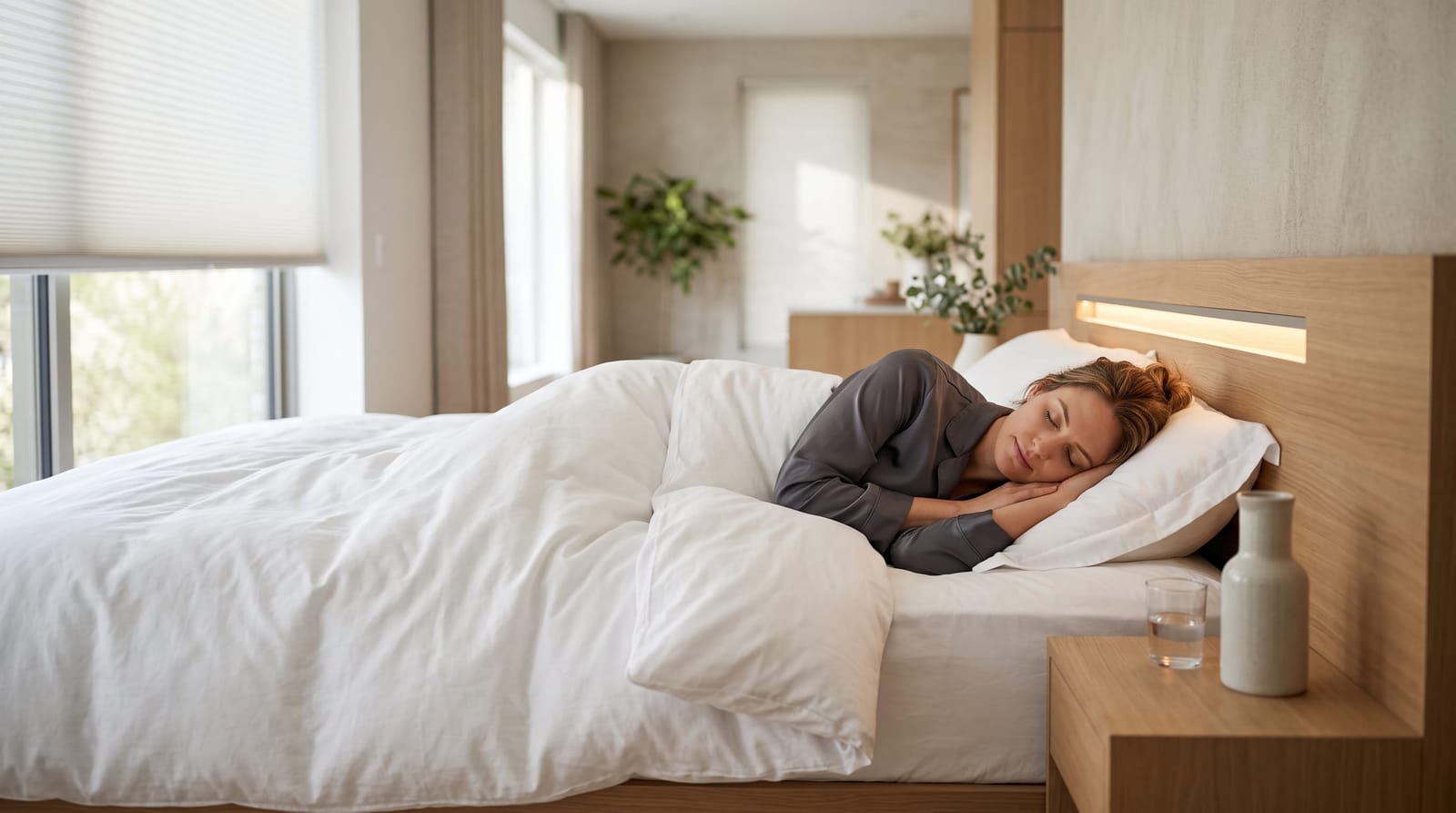
Sleep is the foundation of every wellness practice, and yet it's the one area most luxury homeowners leave entirely to chance. If you've invested in a $5M hillside estate or a sprawling Bel Air compound, your bedroom environment deserves the same level of intentional design as every other space in the home. Smart home automation sleep health solutions make this possible by orchestrating your entire home environment to work in biological harmony with your body's natural rhythms: automatically, every single evening, without a single manual adjustment.
This post dives into exactly how automated evening sequences support deep, restorative sleep, and why they're becoming a non-negotiable feature in serious wellness-focused residences across Los Angeles. For broader context, see our guide on what is a wellness smart home and how these systems are being integrated at scale.
Why the Hour Before Bed Determines the Quality of Your Night
The science is well-established: your body doesn't transition from wakefulness to sleep in an instant. The process takes roughly 60 to 90 minutes and is governed primarily by melatonin secretion, core body temperature, and the gradual quieting of the nervous system. In a traditional home, even a beautifully decorated one, that biological process has to fight against overhead LEDs still running at daylight temperatures, HVAC systems cycling at daytime setpoints, and ambient sound bleeding in from home theaters or outdoor mechanical equipment.
Smart home automation sleep health design solves this by treating the pre-sleep window as a dedicated, programmable phase of the day. Rather than relying on willpower or manual adjustments, the home itself transitions through a carefully engineered sequence that mirrors what your body needs. In large estate settings, where master suites are often separated from main living areas by significant square footage, this kind of automation becomes especially critical: there's simply too much environmental surface area to manage manually.
The goal isn't luxury for its own sake. It's physiological alignment. And smart home automation makes sleep health optimization genuinely achievable at scale.
Circadian Lighting Automation: The Most Powerful Sleep Variable You Can Control
Blue-wavelength light, the kind emitted by most modern LED fixtures at full brightness, directly suppresses melatonin production. Exposure to high-intensity, high-color-temperature light after 8 PM can delay your body's sleep signal by one to three hours. In luxury residences with extensive lighting plans featuring dozens of zones, this is a meaningful problem.
Smart home automation addresses this through circadian lighting sequences that begin automatically at a pre-set evening time: typically 7 or 8 PM. During this phase, the system executes the following simultaneously across all relevant zones:
- Color temperature shifts from 4000K-5000K (cool daylight) down to 1800K-2700K (warm amber tones)
- Overall dimming across bedroom, hallway, and adjacent spaces, often to 10-25% of full output
- Accent lighting in entertainment areas fades or switches off entirely
- Exterior landscape lighting, if visible from bedroom windows, transitions to low red-spectrum settings
In hillside homes with floor-to-ceiling glass and canyon views, smart home automation sleep health programming also accounts for exterior light intrusion: triggering motorized shades or blackout drapery on a schedule, rather than waiting for the homeowner to remember.
Motorized Shades and Thermal Comfort: Two Systems Working as One
Sleep research consistently shows that a slight drop in core body temperature, typically 1 to 2 degrees Fahrenheit, is essential for initiating deep sleep stages. In Los Angeles, where ambient evening temperatures can remain warm for much of the year and where large estate windows absorb significant radiant heat, this is an environment-specific challenge that smart home automation sleep health programming directly addresses.
A well-designed evening sleep scene sequences both motorized shading and HVAC together:
- Motorized shades close across south- and west-facing bedroom windows 30 to 45 minutes before the target sleep time, blocking residual radiant heat gain and eliminating light intrusion from city glow or neighboring properties
- HVAC setpoints adjust automatically: typically lowering the master suite temperature to 65-68°F, which most sleep researchers identify as the optimal thermal range for restorative sleep
- Zone-specific climate control ensures the bedroom temperature adjusts independently from common areas still in use by other household members or staff
For estates with radiant floor heating, smart home automation can coordinate floor temperature setbacks that prevent radiant heat from counteracting the cooling effect: a detail that generic smart thermostats simply can't manage without integration-level programming.
Audio, Voice Prompts, and Whole-Home Sound Management
Acoustic environment is one of the most underappreciated variables in sleep health: particularly in hillside or canyon properties where outdoor sound (wind, wildlife, neighboring properties) is unpredictable. Smart home automation sleep health programming addresses audio on two simultaneous fronts: reducing stimulating sound and introducing deliberate acoustic support.
An automated evening sequence in a luxury residence typically includes:
- Whole-home audio systems fading volume gradually across all zones during the evening transition window
- Home theater or media room systems entering standby mode automatically at a defined time
- Bedroom speakers cuing low-volume sleep content: binaural beats, pink noise, nature soundscapes, or preferred sleep playlists from integrated streaming services
- Voice assistant prompts disabled or set to do-not-disturb mode to prevent accidental activation during sleep hours
In multi-wing estates where other household members maintain different schedules, smart home automation sleep health configurations can be applied at the zone level: ensuring the master suite environment is fully optimized without disrupting entertainment systems in secondary wings or guest quarters.
Designing the Complete Evening Scene: How It All Works Together
The most effective smart home automation sleep health implementations don't treat lighting, shading, HVAC, and audio as separate systems with separate controls. They treat the entire home as a single, integrated organism, and program an evening scene that sequences every variable in coordinated order over a 60 to 90-minute transition arc.
Here's what a typical luxury residence evening sleep scene might look like in practice:
- 7:30 PM: Circadian lighting begins shifting warm across all interior zones; motorized shades begin closing on west-facing exposures
- 8:00 PM: Whole-home audio volume reduces by 30%; outdoor lighting transitions to low amber settings
- 8:30 PM: HVAC setpoint lowers to 66°F in master suite; remaining overhead lighting dims to 15%
- 9:00 PM: Full blackout shade deployment; bedroom sleep audio activates at low volume; media systems enter standby
- 9:30 PM (sleep onset target): All active lighting extinguishes; system enters night mode with motion-sensitive low-level pathway lighting only
This kind of orchestration is impossible to replicate manually, night after night, with any consistency. It's precisely what separates a smart home from a wellness smart home, and why smart home automation sleep health design is now a key specification in new luxury builds and whole-home renovations across Los Angeles.
It's also worth noting that the inverse of this sequence, a smart morning routine that reverses each of these conditions to wake the body naturally, is equally important. Morning routine automation works as the bookend to the evening sleep scene, making the full 24-hour cycle a deliberate wellness system rather than a series of isolated adjustments.
Frequently Asked Questions
Can smart home automation sleep health settings be customized for different household members with different sleep schedules?
Yes. Modern integrated smart home platforms, including Control4, Crestron, and Savant, support user-specific or zone-specific scene programming. A primary homeowner's master suite can run a 9 PM evening sequence while guest wings or secondary bedrooms maintain entirely different schedules. Wake-up times and scene triggers can also be configured individually, including via mobile app adjustments made the same evening.
How does smart home automation manage sleep health in hillside homes with significant glass and open views?
Hillside properties require particular attention to light intrusion and thermal management. Smart home automation sleep health programming for these environments typically incorporates solar-tracking shade logic, blackout layering (sheer plus blackout on the same motorized system), and zone-specific HVAC management that accounts for radiant heat gain through large glass planes. These configurations are designed during the integration phase and require custom programming: they're not achievable with off-the-shelf smart devices.
Is smart home automation for sleep health something that can be added to an existing luxury residence, or does it require new construction?
Retrofit integration is absolutely possible and is, in fact, the most common implementation scenario in established Los Angeles luxury neighborhoods. The scope depends on existing infrastructure, homes with structured wiring and pre-installed conduit allow for cleaner integration, but wireless smart home platforms have made sleep health automation viable in virtually any residence without major construction disruption.
What's the difference between a basic smart thermostat and a fully integrated smart home automation sleep health system?
A smart thermostat controls one variable, HVAC, on a schedule. A fully integrated smart home automation sleep health system coordinates lighting, shading, audio, climate, and security simultaneously, with all systems communicating through a central processor that sequences them in a defined order. The result is a compound environmental effect that no single device category can replicate on its own. It's the difference between adjusting one instrument and conducting an orchestra.
The Bottom Line on Smart Home Automation and Sleep Health
Sleep health isn't a passive outcome: it's an environment you design. Smart home automation gives luxury homeowners in Los Angeles the tools to engineer that environment precisely, consistently, and automatically, night after night. When circadian lighting, motorized shading, HVAC management, and audio control work in sequence, the result is a bedroom environment that actively supports the physiology of deep, restorative sleep rather than working against it.
This is one specific, high-impact application within the larger framework of wellness smart home systems: a category that encompasses everything from air quality monitoring to morning wake routines. If you're exploring what full wellness integration looks like for your residence, our overview of what is a wellness smart home provides the broader architectural context for how these systems fit together.