Lutron Homeworks vs RadioRA vs Caseta: Which System Is Right for Your Home?
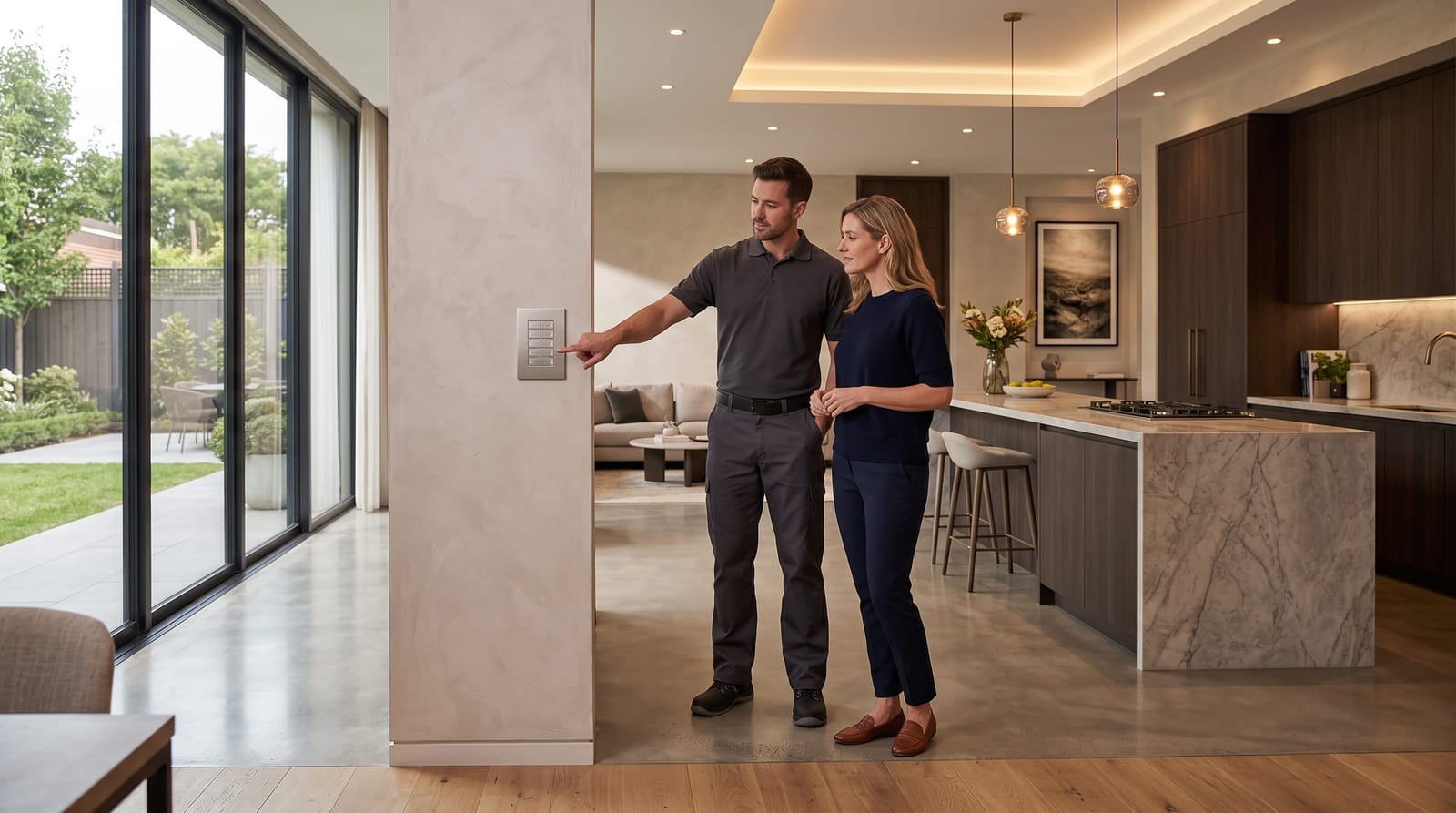
When exploring a luxury lighting control system for your Los Angeles home, one question comes up more than almost any other: which Lutron platform should I choose? Lutron offers three distinct residential tiers, Caseta, RadioRA 3, and HomeWorks QS, and the differences go far beyond price. Each system is designed for a specific type of home, lifestyle, and level of customization. This Lutron HomeWorks vs RadioRA comparison will break down what separates these three platforms so you can walk into a consultation with a clear sense of where you stand.
Understanding the Three Lutron Tiers at a Glance
Lutron has built its residential lineup around a tiered architecture: each level unlocking more control, more customization, and more integration capability than the one below it. Here's how they stack up in plain terms:
- Caseta: Entry-level wireless dimming. Designed for renters, smaller homes, or homeowners who want smart lighting without a professional installation. Approximate cost per dimmer: $70.
- RadioRA 3: Mid-tier whole-home wireless system. Professional installation required. Ideal for mid-size to larger homes that need room-by-room coordination without the full luxury price tag. Approximate cost per dimmer: $200.
- HomeWorks QS: Lutron's flagship residential platform. Fully engineered, dealer-installed, and capable of controlling thousands of devices across the most complex estates. Approximate cost per dimmer: $700.
These price differences aren't arbitrary: they reflect fundamentally different levels of programming depth, hardware quality, keypad aesthetics, and system scalability. Choosing the wrong tier for your project can mean either overpaying or under-building.
Caseta: The Right Choice for Simple Setups
Caseta is Lutron's consumer-grade system, and it does what it promises well: reliable wireless dimming with a straightforward app and compatibility with major smart home platforms like Apple HomeKit, Amazon Alexa, and Google Home. For a guest house, a small apartment, or a homeowner dipping their toe into lighting automation, Caseta is a legitimate starting point.
However, Caseta has clear ceiling limits that make it unsuitable for luxury residential projects:
- Limited to 75 devices per system
- No support for designer keypad lines (Palladiom, Alisse, Avienna)
- Minimal scene programming depth
- No integration with high-end AV and automation platforms at the hardware level
If you're planning a whole-home experience, one where lighting responds to time of day, integrates with motorized shades, and reflects the architectural intent of the space, Caseta won't get you there. It's a stepping stone, not a destination for luxury builds.
RadioRA 3: The Mid-Luxury Sweet Spot for Many LA Homes
For many Los Angeles homeowners with 3,000-8,000 square foot homes, RadioRA 3 represents an exceptional balance of capability and value. It's a professionally installed, whole-home wireless system that supports up to 200 devices and offers meaningful scene control, scheduling, and third-party integrations with systems like Control4, Savant, and Crestron.
The Lutron HomeWorks vs RadioRA comparison becomes most relevant at this tier. RadioRA 3 supports Lutron's Sunnata and Diva keypad styles: attractive and functional, though not at the same level of bespoke customization as HomeWorks' Palladiom or Alisse lines. For circadian rhythm lighting programs and wellness-driven lighting sequences, RadioRA 3 can execute time-based lighting schedules effectively, making it a practical platform for homeowners interested in biologically optimized environments.
Installation costs for RadioRA 3 in a four-bedroom home typically range significantly depending on scope: always get a site-specific quote from a licensed Lutron dealer to understand the full investment for your project.
RadioRA 3 is a strong fit if:
- Your home is under 7,000-8,000 square feet
- You want professional whole-home control without maximum-tier complexity
- Your project has a defined budget ceiling
- You're integrating with a mid-tier AV or automation system
HomeWorks QS: The Standard for True Luxury Estates
Lutron HomeWorks QS is the platform that architectural lighting designers, interior designers, and estate integrators specify when there are no compromises. It's engineered for homes where the lighting system is itself a design element, not just a functional layer.
What separates HomeWorks in any serious Lutron HomeWorks vs RadioRA comparison:
- Unlimited scalability: HomeWorks can manage thousands of devices across multiple structures on a single estate
- Designer keypads: Palladiom, Alisse, and Avienna keypads offer engraved buttons, custom finishes, and architectural-grade aesthetics that RadioRA and Caseta cannot match
- Superior programming flexibility: Lutron's HomeWorks software allows integrators to create highly granular scenes, complex conditional logic, and time-based sequences that go far beyond RadioRA's capabilities
- Full fixture support: HomeWorks supports a wider range of architectural lighting fixtures, ELV/MLV/0-10V loads, and specialty dimming scenarios
- Integration depth: Native integration with virtually every major AV and smart home automation platform at the hardware level
For estates over 8,000 square feet, multi-structure properties, or any project where the lighting design is architecturally significant, HomeWorks QS is the correct specification. The higher per-device cost reflects engineering-grade hardware and a programming ecosystem that dealers spend years mastering.
HomeWorks is also the platform best suited for advanced circadian lighting programs: the kind that shift color temperature and intensity across a full 24-hour cycle to support sleep, focus, and energy in biologically meaningful ways. For homeowners exploring wellness-driven lighting design, HomeWorks offers the precision that a true circadian protocol demands.
Lutron HomeWorks vs RadioRA vs Caseta: Side-by-Side Summary
| Feature | Caseta | RadioRA 3 | HomeWorks QS |
|---|---|---|---|
| Installation | DIY or Pro | Professional Required | Certified Dealer Required |
| Device Capacity | 75 devices | 200 devices | Virtually unlimited |
| Keypad Options | Basic | Sunnata, Diva | Palladiom, Alisse, Avienna |
| Programming Depth | Basic scenes | Moderate | Advanced / full custom |
| Best For | Small homes / apartments | Mid-size luxury homes | Large estates / full luxury builds |
| Circadian Lighting | Limited | Capable | Full precision |
Frequently Asked Questions
Can I upgrade from RadioRA 3 to HomeWorks QS later?
In most cases, upgrading from RadioRA 3 to HomeWorks QS requires replacing the central processor and much of the device infrastructure, since the two systems use different hardware architectures. It's generally not a simple swap. If you anticipate expanding your home or your lighting vision, it's worth discussing long-term scalability with your integrator before committing to a platform.
Is HomeWorks QS worth the higher cost for a mid-size home?
For homes under 5,000 square feet with straightforward layouts, RadioRA 3 typically delivers excellent results at a lower investment. HomeWorks begins to demonstrate its value clearly in larger homes, architecturally complex spaces, multi-structure estates, or projects where bespoke keypad aesthetics and granular scene control are a priority. The right answer depends on your specific home: a qualified Lutron dealer can help you assess which platform genuinely serves your needs.
Does Caseta integrate with systems like Control4 or Savant?
Caseta does offer some third-party integrations, primarily through cloud-based APIs and consumer-grade smart home platforms. However, it does not support the deep, hardware-level integration that RadioRA 3 and HomeWorks QS offer with professional automation platforms like Control4, Savant, or Crestron. For a whole-home automation ecosystem, Caseta's integration limitations are a meaningful constraint.
Which Lutron system is best for circadian rhythm lighting in a Los Angeles home?
HomeWorks QS offers the most precise control for circadian lighting programs, including the ability to schedule gradual shifts in color temperature and intensity throughout the day at a granular level. RadioRA 3 can support time-based lighting schedules and is a capable platform for wellness-driven lighting when paired with compatible tunable LED fixtures. Caseta does not have the programming depth needed for meaningful circadian protocols.
Choosing the Right Lutron Platform for Your Home
The Lutron HomeWorks vs RadioRA comparison ultimately comes down to the size and complexity of your home, the depth of customization you want, and the long-term vision for your lighting environment. Caseta is for simple setups. RadioRA 3 is for capable whole-home control in mid-size luxury homes. HomeWorks QS is the specification for estates where lighting is a defining design element. As part of a well-considered luxury lighting control system, the platform you choose shapes everything from daily ambiance to long-term wellness. If you're ready to explore which tier is right for your Los Angeles home, a consultation with a certified Lutron dealer is the right next step.