Luxury Lighting Control Systems for Los Angeles Homes: The Complete Guide
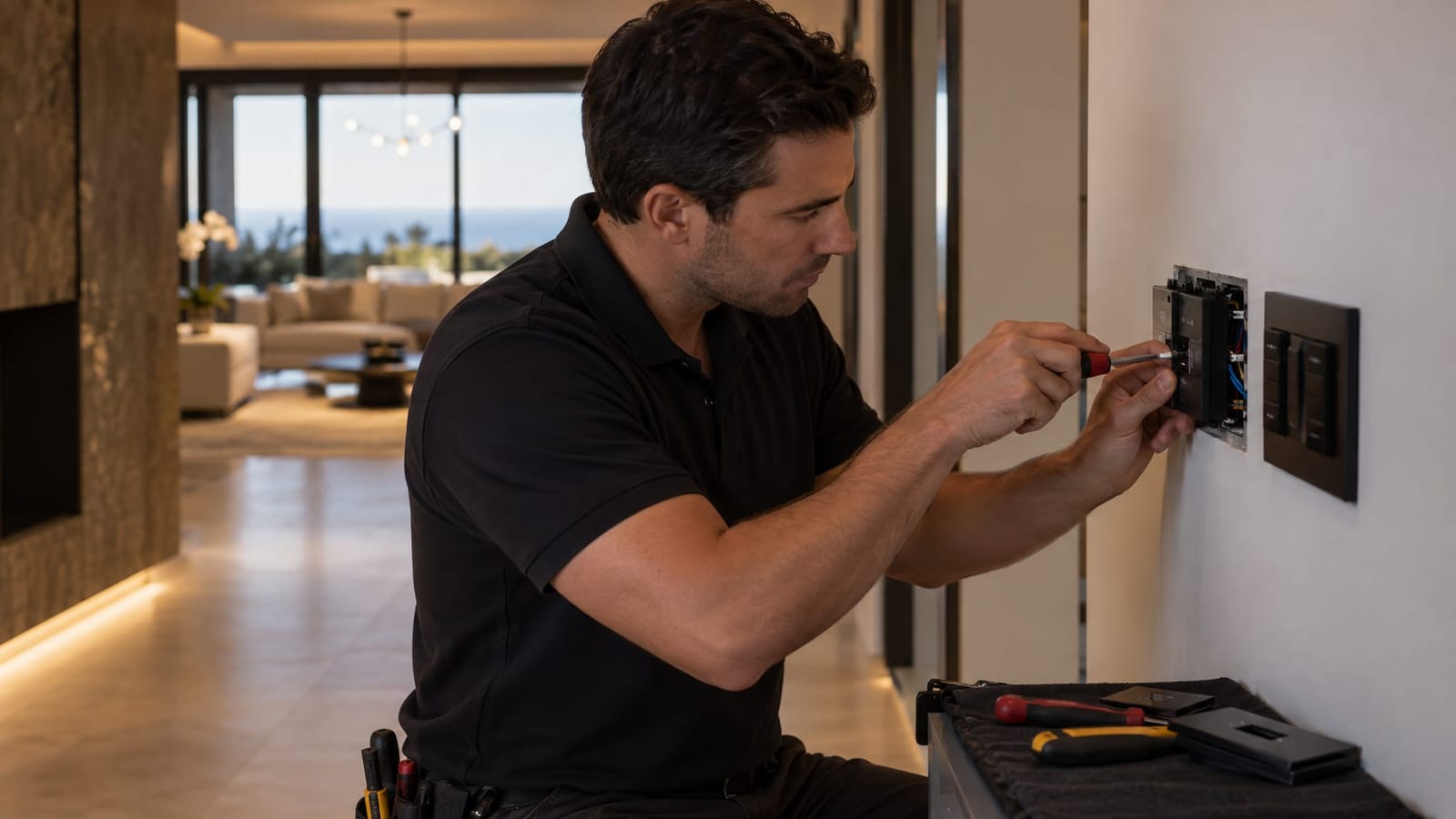
A luxury lighting control system brings separate lighting circuits, fixtures, and rooms into a coordinated experience. Instead of adjusting a wall of switches, you select a setting for cooking, entertaining, reading, or winding down. The system adjusts the appropriate lights, while compatible motorized shades and home automation extend that setting throughout the space.
The best result begins with lighting design, not a control app. Beautiful fixtures still need thoughtful placement, appropriate dimming, and clear separation between task, accent, and ambient light. Control makes those decisions easier to use every day.
For Los Angeles homes with expansive glazing, open-plan interiors, and connected outdoor spaces, the central question is how lighting can support the architecture without demanding attention. This guide explains the design choices, platform distinctions, installation considerations, and ongoing care that shape that result.
What Architectural Lighting Control Actually Does
Architectural lighting control manages groups of lights as part of the home’s design. It goes beyond switching individual bulbs from a phone. A well-planned system gives each lighting layer a purpose and provides a simple way to coordinate those layers.
Three related disciplines contribute to the finished experience:
- Lighting design determines where light belongs, what it illuminates, and how fixtures relate to the architecture.
- Lighting control determines how lights switch, dim, change settings, and respond together.
- Home automation connects lighting with other systems, such as shades and entertainment, where coordinated operation is useful.
Consider a living room with recessed lighting, illuminated shelving, a pendant, and artwork accents. Lighting design establishes the fixtures and their positions. Control allows the pendant to soften while the artwork remains visible. Automation can combine that lighting scene with closing the shades and starting an entertainment setting.
These disciplines are complementary, not interchangeable. Programming cannot correct a fixture that produces uncomfortable glare from the sofa. Equally, a carefully designed room becomes cumbersome when every lighting layer requires a separate adjustment.
The practical starting point is a lighting plan that identifies which fixtures need independent control. That decision matters before selecting keypads, choosing an app, or defining whole-home scenes.
Start with the Architecture and the View
Lighting changes how a room’s proportions, materials, and focal points are perceived. In a design-conscious home, the goal is not simply more illumination. It is the right balance between what draws attention and what recedes.
Separate the lighting layers
Ambient lighting establishes the room’s general illumination. Task lighting supports activities such as preparing food or reading. Accent lighting brings attention to artwork, textured walls, cabinetry, or architectural details. Decorative fixtures contribute their own visual presence.
Keeping these layers independently controllable creates flexibility. Kitchen work surfaces may need clear illumination during preparation, while the adjacent dining area remains subdued. If everything shares one control group, improving one area can compromise another.
Evaluate the room from where people actually sit
A lighting plan looks different from a seated position than from the middle of an empty room. Fixture brightness, visible reflections, and the relationship between interior lighting and glazing deserve attention from the dining table, sofa, bed, and terrace.
For example, a pendant reflected in a large window may become visually prominent after dark. A lower evening setting can preserve the fixture’s presence without making it dominate the view.
Coordinate visible hardware with interior finishes
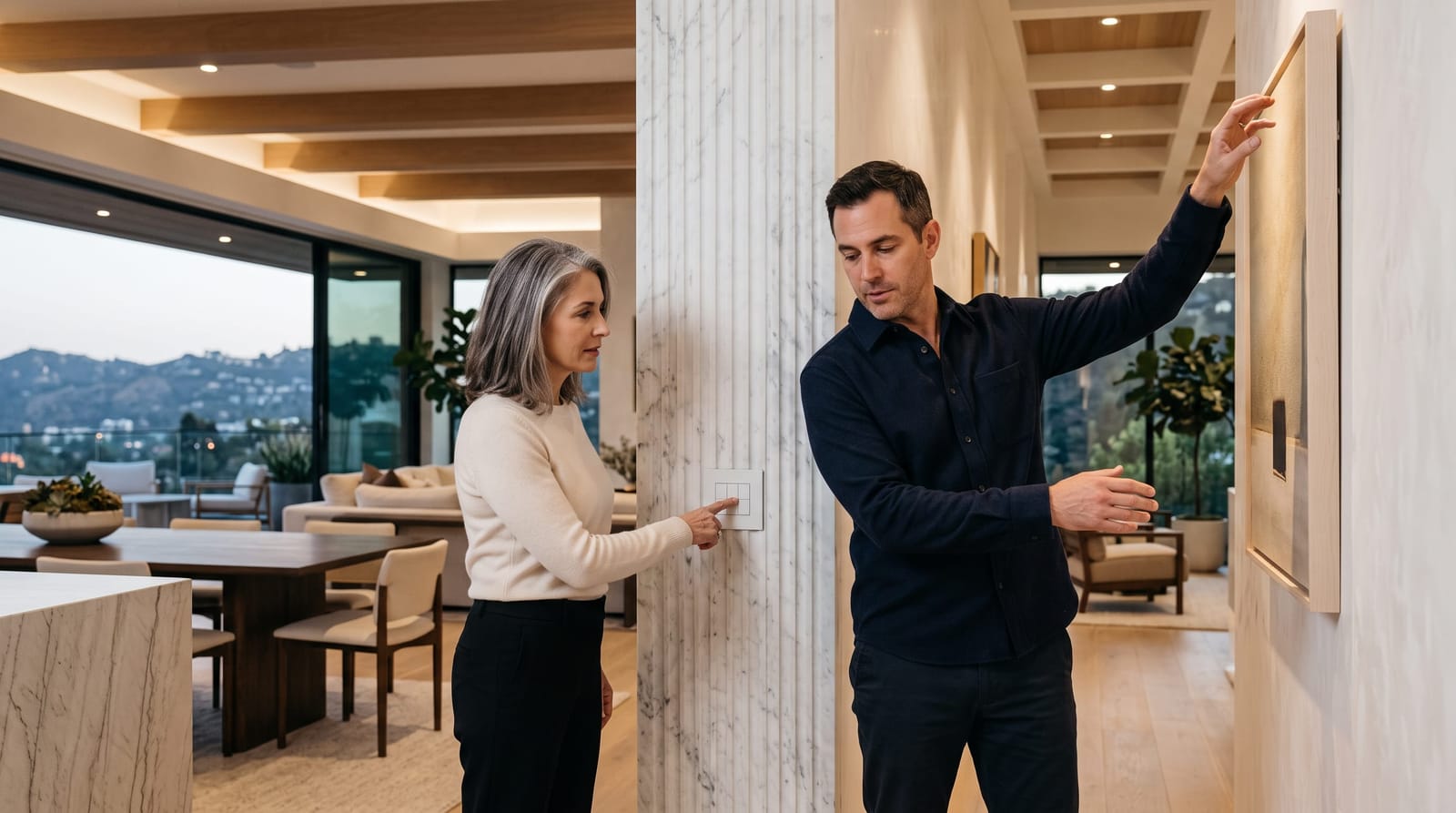
Keypad locations, finishes, engraving, and wall alignment belong in the interior design conversation. So do shade pockets and equipment access. Centralized controls can reduce banks of individual switches, but the remaining controls still need thoughtful placement.
The strongest design brief includes furniture layouts, reflected ceiling plans, material selections, and the intended evening atmosphere. A fixture schedule alone does not explain how the home will be lived in.
Build Lighting Scenes Around Real Activities
A scene is a saved combination of lighting settings. It can affect one room, several connected spaces, or selected areas throughout the home. Its value comes from replacing repeated adjustments with a clear, recognizable action.
Useful scenes describe activities rather than technical settings:
- Cooking: Illuminate preparation surfaces and the sink, while balancing the island and adjacent living area.
- Dining: Give the table visual emphasis, soften surrounding fixtures, and retain enough background light for the room to feel connected.
- Entertaining: Coordinate the entry, living spaces, and terrace without setting every fixture to the same brightness.
- Reading: Bring up the relevant task light while maintaining a comfortable surrounding level.
- Evening: Reduce general illumination and emphasize selected lamps, accents, or architectural details.
- Housekeeping: Provide a brighter working setting that remains separate from everyday presentation scenes.
Scenes also need boundaries. An entertaining setting might include shared rooms but leave bedrooms untouched. A whole-home command that surprises someone in another room creates friction rather than convenience.
Distinguish a scene from its trigger
The scene defines what happens. A keypad press, schedule, or sensor determines when it happens. Keeping these decisions separate makes programming easier to understand.
Predictable routines often suit scheduling. Spaces with changing activities benefit from direct control. Presence-based operation needs particular care in rooms where someone may sit still for an extended period, such as a reading room.
A restrained starting set is usually easier to live with than a long menu of near-identical options. Additional scenes are useful when they resolve a distinct need, not simply because the system supports them.
Circadian Lighting, Tunable White, and Everyday Comfort
Circadian-inspired residential lighting follows a daily pattern, with settings that change across the day and evening. It is often discussed alongside wellness, but its practical design elements are brightness, light appearance, timing, and interaction with daylight.
These terms describe different capabilities:
- Dimming changes the amount of light a fixture produces.
- Dim-to-warm lighting becomes warmer in appearance as it dims, following the fixture’s designed behavior.
- Tunable-white lighting allows the appearance of white light to change between warmer and cooler settings within the equipment’s supported range.
- Scheduled lighting changes settings according to programmed times or events. Scheduling alone does not make a fixture tunable.
This distinction matters when comparing proposals. A system may provide excellent dimming without changing white-light appearance. Another may offer tunable fixtures but still require careful programming to create a coherent daily sequence.
Use the daily routine as the design reference
A morning kitchen setting, a daytime workspace, and an evening sitting room serve different purposes. There is little value in applying one identical lighting sequence everywhere.
Daylight also changes the experience. A room filled with natural light may need a different electric-light balance than an interior hallway at the same time. Shade position, fixture placement, surface finishes, and personal preferences all affect the result.
At Smart Homes Innovations, we offer LED circadian lighting within our wellness-driven approach to home technology. The design emphasis is a comfortable, adaptable environment rather than a promised health outcome. Sleep difficulties or other medical concerns need individual assessment by a licensed healthcare professional.
Keep personal control available
A daily schedule works best as a useful starting point, not a rigid instruction. Someone working late may prefer brighter task lighting while the rest of the room remains subdued. A dinner gathering may run beyond the usual evening transition.
Programming can account for temporary overrides and define when scheduled behavior resumes. That detail prevents the system from repeatedly undoing a deliberate choice.
Choose the Platform by Its Role in the Home
Lighting control, connected fixtures, and whole-home automation are related purchases, but they answer different questions. Comparing them as though they were interchangeable can obscure what a proposal actually delivers.
The lighting control platform
The lighting platform manages lighting groups, dimming, scenes, and control interfaces. Lutron is a relevant option in this category. Evaluation starts with the home’s scale, wiring approach, fixture requirements, and preferred controls, rather than the brand name alone.
At Smart Homes Innovations, our lighting control and automation work includes Lutron and Crestron. We tailor the system to the homeowner’s routines and the project’s architectural requirements.
The whole-home automation platform
A broader automation platform, such as Crestron, provides another layer of coordination across home systems. It becomes relevant when lighting needs to participate in activities that also involve entertainment, shades, or other integrated functions.
Not every lighting adjustment needs to pass through a whole-home interface. A dedicated room keypad can remain the clearest everyday control, while broader scenes bring several systems together.
The fixtures and their supporting electronics
A control platform cannot give every fixture every capability. The fixture, its supporting electronics, and the control method need to work together. This is particularly important for smooth low-level dimming and tunable-white operation.
Useful proposal questions include:
- Which fixtures support only dimming, and which support changes in white-light appearance?
- Which functions are available from wall controls rather than only through an app?
- How do lighting and shade controls connect?
- Which everyday actions depend on the local network or internet access?
- What capacity remains for planned additions?
A platform demonstration is most useful when it reflects those requirements. A compelling showroom scene is not a substitute for confirming how the specified fixtures and controls will behave together.
New Construction and Retrofit Projects Need Different Approaches
The right system architecture depends partly on access to the building. New construction offers opportunities to coordinate wiring and equipment locations before walls close. An existing home may place greater value on preserving finishes and limiting disruption.
Centralized control
In a centralized arrangement, lighting circuits connect to control equipment in designated locations. Wall keypads issue commands rather than requiring a separate visible dimmer for every lighting group.
This approach supports a clean wall composition, but it also makes early planning important. Wiring routes, equipment space, circuit organization, and future service access become part of the construction design.
Distributed and wireless control
Distributed systems place control devices closer to the lighting circuits they manage. Wireless communication can reduce the need for new control wiring in an existing home.
Wireless does not mean installation-free. Existing wiring, device compatibility, communication paths, and the location of system equipment still affect the design. A retrofit assessment also needs to consider which existing fixtures are worth retaining.
Hybrid arrangements
A hybrid approach combines methods where they make sense. A renovated principal living area might receive more extensive changes, while other rooms retain compatible local controls.
The tradeoff is not simply wired versus wireless. It is the relationship between finish disruption, desired functionality, system organization, and future access. A technically capable solution can still be a poor fit if it requires unnecessary disturbance to completed interiors.
Coordinate Lighting with Motorized Shades and Entertainment
Electric lighting and daylight shape the same room. Treating them as unrelated systems creates extra steps and can produce inconsistent settings.
A useful integrated scene defines both lighting and shade behavior. For a daytime presentation or film, selected shades may close while the relevant room lights dim. For an evening gathering, shades may provide privacy while accent lighting establishes the atmosphere.
Plan shade groups around the windows
Windows on different sides of a home receive different light. Their shade behavior does not always need to match. Glare at a desk, privacy near a neighboring property, and preserving a view are separate priorities.
Fabric and treatment selection also matter. A light-filtering treatment and a room-darkening treatment create different experiences; automation does not eliminate that distinction.
We integrate motorized shades with lighting systems so these functions can operate together. Coordinating shade pockets, fabric choices, and control groups during design helps keep the visible result consistent with the room.
Give combined scenes a clear purpose
Integration is most valuable when it removes a predictable sequence of actions. A movie setting that adjusts lighting and shades has an obvious purpose. Linking unrelated activities can make the home harder to understand.
Outdoor and indoor areas deserve the same restraint. An entertaining scene can connect a living room and terrace while leaving other garden areas on separate controls. This preserves flexibility when only part of the property is in use.
Make the Controls Understandable Without an Explanation
A refined interface communicates through placement and language. Residents and guests should be able to make ordinary lighting adjustments without navigating a floor plan on a touchscreen.
Use recognizable labels
Labels such as “Dining,” “Reading,” and “Evening” explain intent more clearly than circuit numbers or vague names. Consistent terminology across keypads and apps also reduces the mental work of operating the home.
Button placement matters as much as wording. Room controls belong where people naturally enter or settle into the space. Whole-home commands need deliberate placement so that a casual adjustment does not affect unrelated rooms.
Keep direct adjustment available
Scenes establish a starting point, but rooms need flexibility. A simple way to raise or lower the current setting is often more useful than adding another narrowly defined preset.
Apps and touchscreens serve well for broader adjustments and less frequent functions. They do not need to replace every familiar wall interaction.
Define behavior when connections change
Local keypads, the home network, internet access, and remote apps are distinct parts of a system. Their dependencies differ by design.
The project documentation can identify which controls operate locally and how the system resumes after a power interruption. Addressing this during planning is more useful than assuming every function behaves the same way.
Why Professional Design and Installation Matter
Lighting control sits at the intersection of architecture, electrical work, fixture selection, software configuration, and interior design. Professional coordination matters because a decision in one area can limit another.
A decorative fixture selected late may require a different control method. A wall layout may leave insufficient space for the intended interface. A beautifully concealed equipment location may become difficult to service. Resolving these relationships is the substantive work behind discreet integration.
A thorough project follows a connected sequence:
- Define the experience. Document activities, room relationships, preferences, and the functions that need to work together.
- Coordinate the lighting plan. Review fixture locations and independently controlled layers with the architect, designer, and electrical team.
- Check compatibility. Match fixtures, supporting electronics, and control equipment. Representative testing helps evaluate dimming behavior before repeating a selection throughout the home.
- Document installation requirements. Establish control locations, wiring routes, equipment access, labeling, and responsibilities across trades.
- Install and configure. Connect the equipment, define lighting groups, program scenes, and establish integration behavior.
- Commission the finished spaces. Adjust settings in the actual rooms, including after dark, and evaluate transitions, shade coordination, and manual overrides.
- Complete the handover. Provide an understandable control overview and organized system documentation.
Commissioning is more than confirming that every light switches on. It tests whether the room behaves as intended. Furniture, glazing, artwork, and surface finishes all influence the final scene settings.
Smart Homes Innovations is based in Van Nuys. We design, engineer, and install custom home technology systems, including lighting control and new construction pre-wire, with an emphasis on precise installation and discreet architectural integration.
Understand Scope, Timing, and Ongoing Care
A meaningful lighting control proposal explains the experience it delivers and the work required to achieve it. Comparing equipment lists alone can hide substantial differences in design, installation, and programming scope.
What shapes the project cost?
The major variables include the extent of the home being controlled, existing wiring conditions, fixture capabilities, keypad selections, shade integration, and the complexity of coordinated scenes.
Tunable lighting involves different equipment and programming considerations from conventional dimming. A finished-home retrofit also presents different labor conditions from an open-wall installation.
For a useful comparison, look for clearly described lighting groups, interfaces, installation responsibilities, programming, commissioning, documentation, and support. A narrower proposal may be appropriate, provided its boundaries match the intended result.
What shapes the schedule?
Project timing depends on decisions as well as installation. Fixture approvals, finish selections, construction progress, equipment delivery, and access to completed rooms affect the sequence.
Early coordination is particularly valuable for centralized wiring, concealed shade pockets, and integrated keypads. Final scene tuning belongs late enough in the project to reflect the finished interior.
What happens after handover?
Living in the home may reveal useful refinements: a scene that needs more task light, a schedule that starts too early, or a button label that could be clearer. These are reasons to consider service support separately from equipment warranty coverage.
Our first year of service is included. Equipment warranties and ongoing service address different needs, so both belong in the project discussion.
Organized documentation also supports future work. Fixture substitutions, room renovations, and system additions are easier to plan when the original lighting groups, equipment, and programmed functions are clearly recorded.
Deep Dive Topics
These focused articles explore decisions introduced in this guide:
- Platform selection: Lutron lighting control residential looks more closely at Lutron’s role in a coordinated residential lighting experience.
- Design and control: The architectural lighting control system article explains how lighting design and control contribute different, complementary functions.
- Daily lighting patterns: Circadian lighting home automation explores changing light settings throughout the day and their place in a wellness-oriented home.
A Complete System Should Feel Simple
The most successful lighting control design is not the one with the longest feature list. It is the one that gives each lighting layer a purpose, respects the architecture, and makes the right setting easy to reach.
A useful project brief starts with the rooms, activities, daylight conditions, and visible finishes. Platform selection and programming then serve those priorities. The result is a home where the sophistication sits behind the scenes, while the everyday experience remains clear and intuitive.