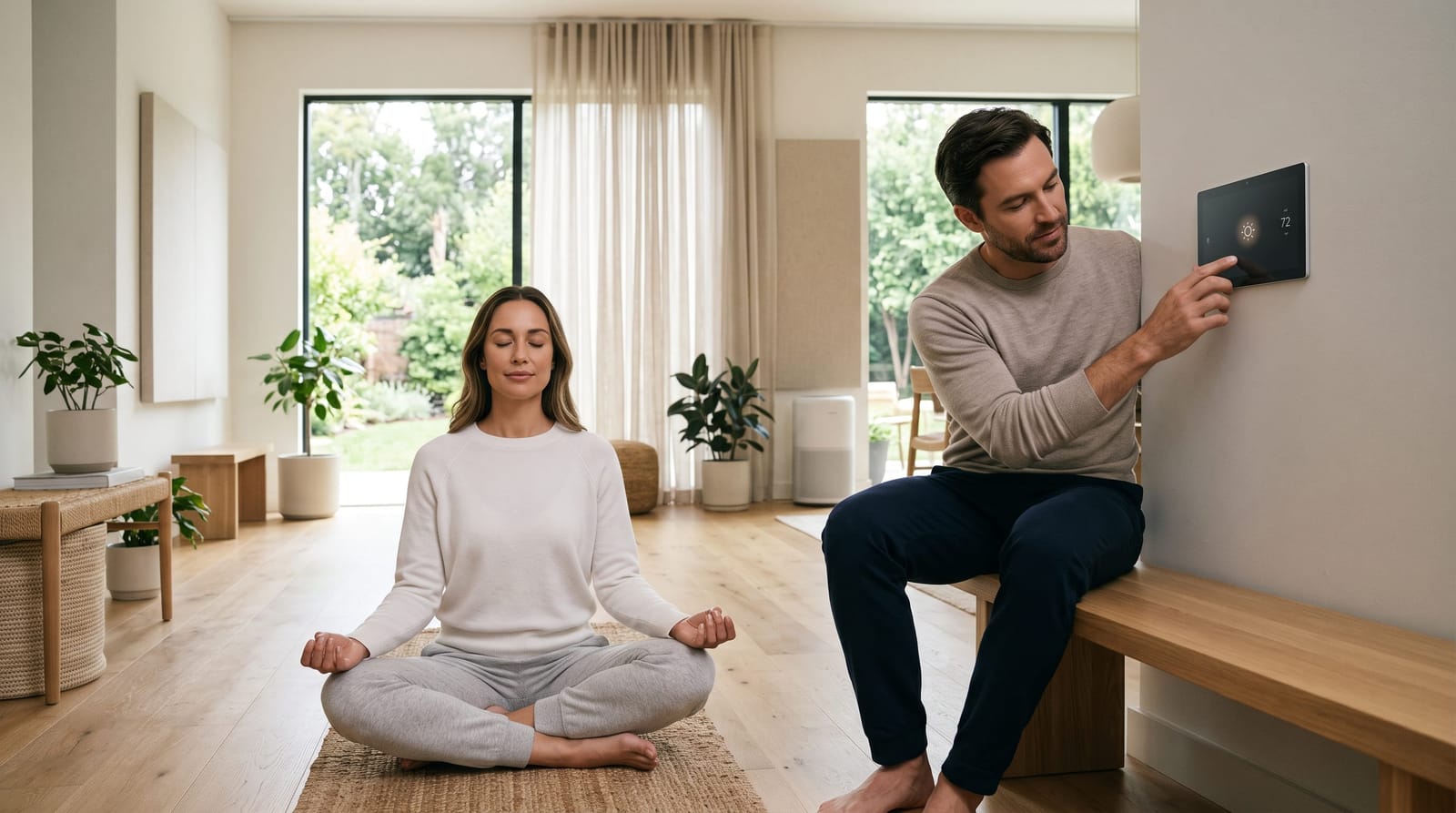
Morning Routine Automation: How a Wellness Smart Home Starts Your Day
Your morning sets the tone for everything that follows: your energy, your focus, your mood. For homeowners exploring morning routine smart home automation, the question isn't whether technology can improve their mornings, but how precisely it can be orchestrated. As part of a broader what is a wellness smart home framework, morning automation is one of the most immediately felt benefits. This guide walks through a real-world automated morning, step by step, so you can understand exactly what's possible and how to build it for your own Los Angeles luxury residence.
Step 1: Wake Up with Circadian-Aligned Smart Lighting
The foundation of any effective morning routine smart home automation sequence begins not with an alarm, but with light. Circadian lighting systems, typically built on platforms like Lutron Ketra, Philips Hue, or Control4, begin a gradual sunrise simulation 20 to 30 minutes before your target wake time. The light starts at a warm amber hue (mimicking pre-dawn) and slowly shifts toward a cooler, brighter white as your wake time approaches.
This approach works with your body's natural photoreceptors rather than against them. Harsh alarms and instant overhead lighting create a stress response first thing in the morning. A slow light transition signals wakefulness gradually, which many users find helps them feel more alert and less groggy upon rising, though individual experiences vary, and a wellness professional can offer personalized guidance on sleep and wake routines.
To build this step into your system:
- Set a "Wake Scene" in your smart home controller (Control4, Crestron, or Savant are common in luxury builds).
- Program light levels to ramp from 1% warm white to 80% daylight-balanced white over a 25-minute window.
- Assign your target wake time and enable the scene on weekdays or specific schedule days.
- Layer in accent lighting in adjacent spaces, hallway, bathroom, to subtly extend the wake signal through your home.
This single step alone transforms the experience of waking up. Many homeowners who implement morning routine smart home automation report this as the feature they most appreciate after installation.
Step 2: Motorized Shades Rise with the Sun
Natural light is the most powerful circadian cue available, and your motorized window shades are the mechanism that delivers it on schedule. Paired with your lighting scene, automated shades can begin lifting at a preset time or be triggered by the lighting sequence itself: creating a seamless, layered wake-up environment.
In a Los Angeles setting, this is particularly effective. The city's reliable morning light means your south- and east-facing windows can contribute meaningful natural brightness by 7:00 a.m. on most days. Lutron Sivoia QS and Hunter Douglas PowerView are two systems commonly integrated into luxury wellness smart homes for this purpose.
Programming your morning shade sequence:
- Identify which rooms you wake and move through in the morning: bedroom, bathroom, kitchen.
- Set shades in the bedroom to lift to 40% at wake time, then 100% ten minutes later.
- Program kitchen and living area shades to be fully open by the time you're likely to arrive there.
- Use your home's automation hub to link shade scenes to your lighting Wake Scene so they activate together.
This integration between morning routine smart home automation and motorized shading ensures that by the time you're out of bed, your entire home environment is already calibrated for an alert, energized start.
Step 3: Audio, Climate, and Appliance Coordination
Light and shades establish the visual environment, but a fully realized morning routine smart home automation system engages multiple senses simultaneously. Here's how audio, temperature, and kitchen appliances layer into the sequence:
Audio
Smart speakers or a whole-home audio system (Sonos, Bowers & Wilkins, or Crestron-integrated systems are popular in premium builds) can begin playing a preferred morning playlist, podcast, or news briefing at low volume: starting perhaps five minutes after your wake light sequence begins. Volume can gradually increase so it feels like a natural part of the environment rather than a jarring interruption.
Climate Control
Your smart thermostat, whether a Nest, Ecobee, or fully integrated HVAC controller, can be programmed to reach your preferred morning temperature before you wake. For many Los Angeles homeowners, this means a slight cool-down from overnight temperatures, shifting to a comfortable 70°F range by 6:30 a.m. Bathroom-specific climate controls, including heated floors and fan automation, can also be tied to the morning scene.
Kitchen Appliances
A smart plug or connected coffee maker can be scheduled to begin brewing at the moment you're likely to arrive in the kitchen. Some premium systems integrate directly with appliance APIs to initiate brewing sequences without manual timers.
Coordinating these elements requires a central automation platform that can trigger multiple device categories simultaneously. This is where professional integration, rather than DIY smart speakers, makes a meaningful difference in a luxury wellness context.
Step 4: Air Quality Reporting and Environmental Awareness
A distinguishing feature of a true morning routine smart home automation system, one oriented around wellness, is environmental monitoring. Air quality sensors placed throughout the home can deliver a morning status report: indoor CO₂ levels, particulate matter (PM2.5), humidity, and VOC concentrations.
This data can appear on a bedside display, a smart mirror, or a dashboard panel in the kitchen. If air quality falls outside preferred parameters overnight, common during high-pollen days or wildfire events in Los Angeles, your system can have already activated HEPA filtration or adjusted fresh-air intake before you wake.
To integrate air quality reporting into your morning automation:
- Install dedicated air quality monitors (Airthings, uHoo, or Foobot are commonly integrated options) in bedrooms and main living areas.
- Connect sensor data to your automation hub so thresholds can trigger responses (e.g., activating a whole-home air purifier when PM2.5 rises).
- Configure a morning summary to display air quality data on a dashboard or be read aloud via smart speaker.
- Log data over time so your integrator can identify patterns and refine your system accordingly.
This is the layer that transitions a smart home from convenient to genuinely health-supporting, and it connects directly to how smart home automation sleep health monitoring works through the overnight hours that precede your morning.
Frequently Asked Questions
What platform is best for building a morning routine smart home automation sequence?
For luxury homes in Los Angeles, professionally integrated platforms like Control4, Crestron, and Savant offer the most seamless multi-device coordination: linking lighting, shades, audio, HVAC, and appliances under a single automation engine. Consumer-grade platforms like Google Home or Apple HomeKit can handle simpler sequences but often lack the device compatibility depth that complex morning routines require across premium hardware categories.
How long does it take to program a complete morning automation scene?
A basic morning scene, lights, shades, and thermostat, can typically be configured in a few hours by a professional integrator already familiar with your system. A full wellness-oriented morning routine that includes audio, air quality response, appliance coordination, and conditional logic (weekday vs. weekend, seasonal adjustments) may require a half-day programming session and follow-up refinement over the first few weeks of use.
Can morning routine automation adjust based on what time I actually wake up?
Yes: more advanced systems can use motion sensors, sleep-tracking integrations (via compatible wearables or under-mattress sensors), or "good morning" voice commands to trigger the morning scene at the moment you actually stir, rather than on a fixed schedule. This adaptive approach is increasingly popular in wellness-focused smart homes where rigid schedules don't suit varied lifestyles.
Is morning routine smart home automation difficult to adjust if my schedule changes?
Not with a well-designed system. Most professional platforms allow homeowners to adjust wake times, scene sequences, and device behaviors through an intuitive app or touchpanel, without needing to call an integrator for every change. The initial programming is where precision matters; day-to-day adjustments are designed to be user-managed.
Conclusion
Morning routine smart home automation isn't about novelty: it's about building an environment that supports how you want to feel from the moment you wake. When circadian lighting, motorized shades, preferred audio, climate control, and air quality monitoring all activate in sequence, the result is a morning that feels intentional rather than reactive. For Los Angeles homeowners building wellness-first residences, this level of morning routine smart home automation is both achievable and transformative. Your home's technology should work as hard as you do: starting at dawn.