What Does a Healthy Smart Home Actually Include?
If you've been researching ways to make your home work harder for your well-being, you've likely come across the phrase "healthy smart home", and wondered exactly what that means in practice. It's more than a security camera and a voice assistant. A truly healthy smart home weaves together several interconnected systems, air quality, lighting, shading, sound, and automation, to create a living environment that actively supports how your body and mind function every single day. This guide breaks down each core component in plain language, no technical background required.
Air Quality: The Foundation of a Healthy Smart Home
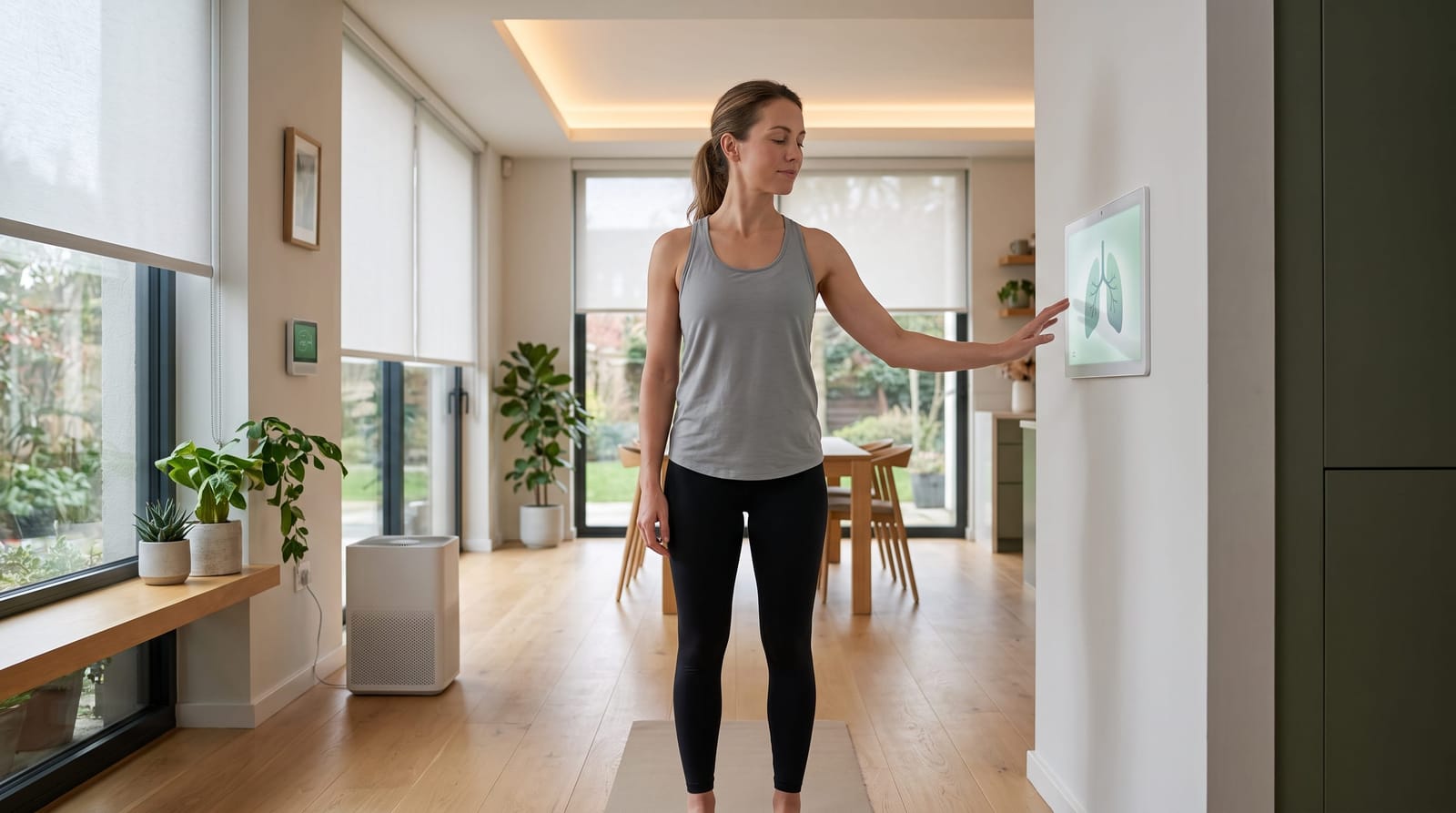
Indoor air can contain pollutants at concentrations 2 to 5 times higher than outdoor air, according to the U.S. Environmental Protection Agency: a striking figure given that most people spend roughly 90% of their time indoors. In a healthy smart home, air quality isn't left to chance. Instead, sensors monitor the air continuously and trigger responses automatically.
These systems typically track several key variables in real time:
- Particulate matter (PM2.5): Fine particles from cooking, candles, or outdoor pollution that can irritate the respiratory system
- Carbon dioxide (CO₂): High CO₂ levels, often above 1,000 parts per million, are linked to drowsiness and reduced cognitive performance
- Volatile organic compounds (VOCs): Gases emitted from paints, cleaning products, and furniture
- Carbon monoxide: An odorless, colorless gas that standard detectors catch but smart systems can also log over time
- Humidity: Levels below 30% dry out airways; levels above 60% encourage mold growth
When sensors detect a problem, say, CO₂ climbing after a dinner party, the system can automatically adjust the HVAC, open motorized windows, or activate fresh-air ventilation without you lifting a finger. For a deeper look at how this detection and response loop actually works, the post on how indoor air quality monitoring works in a smart home system covers the technology in detail.
Lighting: Supporting Your Body's Natural Rhythms
Light is one of the most powerful regulators of human biology. Exposure to blue-spectrum light in the evening suppresses melatonin production and disrupts sleep, while insufficient natural light during the day can dampen mood and alertness. A healthy smart home addresses both problems through intelligent, automated lighting design.
Here's what that looks like in a well-configured residence:
- Circadian tuning: Light temperature shifts automatically throughout the day: cool white (around 5,000-6,500K) in the morning to support alertness, warming to amber tones (2,200-2,700K) by evening to ease the body toward sleep
- Daylight harvesting: Sensors measure incoming natural light and dim artificial fixtures proportionally, so total light levels stay consistent without glare
- Wake-up scenes: Programmed gradual brightening replaces abrupt alarm jolts, using light to bring the body out of sleep naturally
- Nighttime safety lighting: Low-level path lighting activates at a biologically neutral color temperature if someone moves through the home after midnight, avoiding a full-brightness shock
In a Los Angeles luxury residence, these scenes are typically layered across indoor fixtures, landscape lighting, and pool areas, all operating as a single coordinated system rather than isolated switches on a wall.
Shading and Solar Control: Managing Light, Heat, and Privacy
Motorized shading is often underestimated as a health feature, but its impact is significant. South- and west-facing rooms in Southern California can experience solar heat gain that drives indoor temperatures well above comfort thresholds, pushing air conditioning systems to work harder and increasing exposure to UV radiation, even indoors. UV rays can penetrate standard glass and contribute to skin damage with prolonged daily exposure.
In a healthy smart home, shading systems work alongside lighting and HVAC to manage the interior environment intelligently:
- Solar-tracking shades: Automated shades lower based on sun position and intensity, blocking direct glare without eliminating the view or daylight entirely
- UV-filtering fabrics: Specific shade materials can block up to 99% of UV radiation while maintaining visible light transmission
- Heat management: By reducing solar heat gain, motorized shades reduce the cooling load on HVAC systems, which also means fewer air quality disruptions from an overworked system
- Integration with lighting scenes: When shades lower, the lighting system compensates automatically, keeping interior illumination levels stable
This kind of coordinated response is what distinguishes a healthy smart home from a collection of individual smart gadgets: everything responds together, without requiring manual adjustments throughout the day.
Acoustic Comfort: Sound as a Health Variable
Noise is rarely the first thing people associate with health-focused home technology, but research consistently links chronic noise exposure to elevated stress hormones, sleep disruption, and reduced concentration. In urban and suburban Los Angeles environments, traffic, construction, and neighborhood activity are constant factors.
A healthy smart home approaches acoustics in two complementary ways:
- Sound masking: Low-level broadband audio, sometimes called white or pink noise, can reduce the perceived intrusiveness of sudden sounds like traffic spikes or doors closing
- Whole-home audio zoning: Music or nature sounds calibrated to appropriate volumes can support focus in work spaces, relaxation in living areas, and sleep in bedrooms, all from a single integrated platform
- Architectural integration: Speakers installed flush into ceilings and walls, combined with acoustic panels that double as design features, manage both sound distribution and reverberation
The goal isn't to fill every room with noise: it's to give the home's occupants deliberate control over their acoustic environment, rather than leaving it to chance.
Automation: The Intelligence That Ties Everything Together
Each system described above can deliver health benefits on its own. But the real power of a healthy smart home emerges when air quality, lighting, shading, and acoustics operate as a unified, intelligent environment. That's the role of whole-home automation.
A well-designed automation layer does several things:
- Responds to occupancy: Systems activate and deactivate based on where people actually are in the home, avoiding wasted energy and unnecessary environmental stimulation in empty rooms
- Runs scheduled routines: Morning, afternoon, evening, and overnight scenes shift the entire home environment in ways that align with the household's daily patterns
- Reacts to sensor data: If an air quality sensor flags elevated VOCs in the kitchen, the automation system can exhaust the space, alert the homeowner, and adjust adjacent zones: automatically
- Adapts over time: More sophisticated platforms learn occupant preferences and environmental patterns, refining their responses without requiring manual reprogramming
For luxury homeowners in Los Angeles, this level of integration is typically delivered through professional installation and programming: ensuring that each system is calibrated to the specific architecture, orientation, and lifestyle of the home rather than configured with generic out-of-the-box settings.
Frequently Asked Questions
What does a healthy smart home include at the most basic level?
At minimum, a healthy smart home includes indoor air quality monitoring (covering CO₂, particulate matter, humidity, and CO), circadian-tuned lighting that shifts color temperature throughout the day, and an automation platform that connects these systems so they can respond to each other. Shading and acoustic control are typically added as the project scope expands.
Is a healthy smart home the same as a regular smart home?
Not exactly. A conventional smart home prioritizes convenience and security: voice control, remote access, and automated locks. A healthy smart home includes those features but is specifically designed with physiological well-being in mind. The technology choices, sensor selection, and automation logic are all oriented around how the environment affects the people living in it.
Can I add healthy smart home features to an existing home, or does it require new construction?
Most healthy smart home systems can be retrofitted into existing residences without major structural changes. Air quality sensors, smart lighting controls, and motorized shades can all be installed in established homes. Whole-home audio and deeper automation integration may involve some in-wall work, but experienced integrators design solutions around each home's existing architecture.
Do healthy smart home systems require ongoing maintenance?
Yes, like any building system, healthy smart home technology benefits from periodic maintenance: sensor calibration, software updates, and filter replacements in air quality systems. Many professional integrators offer service agreements that handle these tasks proactively, ensuring the system continues to perform as intended over time.
Bringing It All Together
What does a healthy smart home include? At its core: clean air that's actively monitored and managed, lighting that works with your body's natural rhythms, shading that controls heat and UV exposure, acoustic environments designed for calm and focus, and intelligent automation that coordinates all of it seamlessly. These aren't luxury add-ons to a standard smart home: they are the defining features of a home built to support the people living in it. For homeowners in Los Angeles considering this kind of environment, the next step is understanding how each component integrates with the others to create something greater than the sum of its parts.