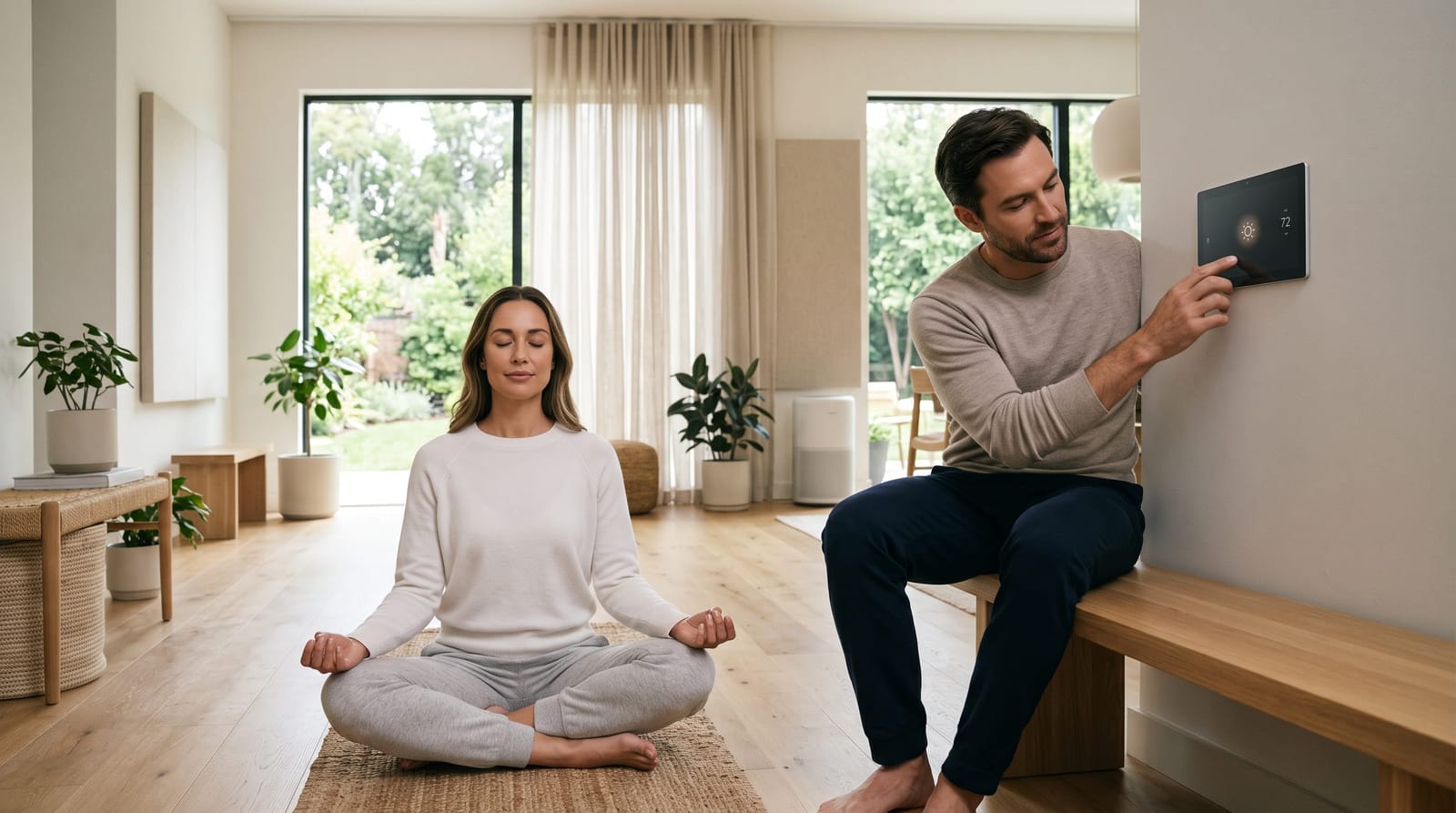
What Luxury Homeowners in Brentwood and Bel Air Expect from a Wellness Smart Home

When you own a $5M+ residence in Brentwood or Bel Air, your standards for technology are not the same as the national average. A wellness smart home in Brentwood and Bel Air is not defined by novelty features or flashy screens: it is defined by invisible precision, health-forward engineering, and seamless integration with an aesthetic that already speaks to excellence. This post profiles the specific expectations high-net-worth homeowners in these two communities bring to smart home consultations, and how a purpose-built wellness system addresses every one of them.
The Brentwood and Bel Air Homeowner Profile: Sophisticated, Wellness-Conscious, and Uncompromising
Brentwood and Bel Air attract some of the most discerning residential buyers in the country. These homeowners, often executives, entertainment industry professionals, and established entrepreneurs, have lived in high-performance environments and hold their primary residence to the same standard. According to the National Association of Realtors, smart home technology now influences purchase decisions for more than 40% of luxury buyers, and in ultra-prime ZIP codes like 90049 and 90077, that figure climbs even higher.
What separates this demographic from general smart home buyers is the convergence of two values: design integrity and health optimization. They are not interested in technology that announces itself. They want circadian lighting that shifts naturally without visible hardware cluttering a ceiling designed by a prominent architect. They want air purification running silently in the background while a dinner party is in progress. The technology should serve the lifestyle, not interrupt it.
Several consistent priorities emerge across consultations with this client segment:
- Whole-home integration managed through a single, elegant interface
- Health-focused environmental controls including air quality, humidity, and circadian lighting
- Acoustic privacy and soundscape management throughout the property
- Discreet hardware that disappears into custom millwork and architectural finishes
- Systems that function intuitively, without requiring a manual or a learning curve
Understanding these expectations is the first step toward building a system that a Brentwood or Bel Air homeowner will actually find indispensable.
Health-Forward Technology: The Non-Negotiables in 2025
The definition of a wellness smart home in Brentwood and Bel Air has evolved significantly since 2020. What was once a premium add-on, circadian lighting, for example, has become a baseline expectation. Today's high-net-worth homeowners arrive at consultations with research already done. They know what MERV-13 filtration means. They have read about the relationship between blue light exposure and sleep quality. They are asking for solutions, not education.
The core health-focused systems that appear on nearly every project brief in these communities include:
- Circadian Lighting Systems: Automated lighting that mirrors the natural progression of daylight: warm and amber in the morning, cooler and brighter midday, and transitioning back to warm amber tones in the evening to support natural melatonin production and better sleep. Studies from the Lighting Research Center indicate that properly calibrated circadian lighting can improve sleep quality by up to 37% for regular users.
- Whole-Home Air Quality Management: Integrated air purification using HEPA and activated carbon filtration, paired with real-time air quality sensors that monitor particulate matter (PM2.5), VOCs, CO2, and humidity. In Los Angeles, where wildfire season presents annual air quality challenges, this feature has become especially relevant for homeowners in hillside communities like Bel Air.
- Smart Temperature and Humidity Control: Zoned HVAC management that maintains precise temperature and relative humidity: typically between 40% and 60%: across different areas of the home, supporting respiratory comfort and skin health without manual adjustment.
- Water Quality Systems: Filtered and structured water delivery at every kitchen and bathroom point of use, monitored through integrated sensors and manageable through the home's central control system.
- Sleep Environment Optimization: Bedroom-specific protocols that automate blackout shading, temperature drops, acoustic isolation, and lighting transitions at user-defined sleep and wake times.
None of these systems operate in isolation. Their power lies in integration: each element communicating with the others through a centralized platform that responds intelligently to occupancy patterns, time of day, and real-time environmental data.
Aesthetics Are Not Optional: Why Discretion Is a Technical Requirement
In Brentwood and Bel Air, the homes themselves are works of architectural intention. Many properties in these communities are designed by nationally recognized firms, feature custom materials sourced internationally, and carry interior design work that represents years of curation. For homeowners at this level, visible technology infrastructure, exposed conduit, mismatched wall panels, consumer-grade switches, is not a minor inconvenience. It is a violation of the design vision.
This is why professional-grade wellness smart home systems in these communities are engineered with concealment as a primary design requirement, not an afterthought. Practical approaches include:
- Flush-mount keypads and control interfaces in materials and finishes that match existing millwork or wall treatments
- In-ceiling and in-wall speaker systems integrated during rough-in construction or renovation to eliminate visible hardware entirely
- Motorized shading systems recessed into ceiling pockets, invisible when retracted
- Equipment rooms designed to consolidate rack systems, routers, and control processors out of all living spaces
- Wireless sensor networks that monitor air quality, occupancy, and environmental data without visible fixtures
The goal is a home that feels completely ambient and responsive, where the homeowner benefits from sophisticated technology without ever being confronted by it visually. This demands close collaboration between the technology integrator, the architect, and the interior design team, ideally beginning at the design development phase rather than during construction or, worse, after move-in.
How Smart Homes Innovations Approaches Brentwood and Bel Air Projects
Delivering a wellness smart home in Brentwood or Bel Air requires more than product selection. It requires a methodology calibrated to the specific demands of these communities: their architectural complexity, their homeowner expectations, and their performance standards.
Smart Homes Innovations approaches projects in these areas through a structured discovery and design process that prioritizes four outcomes:
- Lifestyle Alignment: Every system recommendation begins with a detailed understanding of how the homeowner and their household actually live: sleep schedules, work-from-home patterns, fitness routines, entertainment habits, and wellness goals that extend beyond generalized best practices.
- Design Collaboration: Technology systems are designed in partnership with the project's architectural and interior design teams. No hardware specification is finalized without confirming the visual integration strategy.
- Scalable Architecture: Systems are built on platforms that accommodate future additions, new wellness technologies, expanded automation, or changes in household needs, without requiring complete replacement of existing infrastructure.
- White-Glove Commissioning and Support: Each project concludes with thorough on-site commissioning, personalized client orientation, and ongoing support that reflects the service standard this client demographic expects across every category of their lives.
For homeowners evaluating the full scope of what these systems can offer, the complete guide to wellness smart home systems provides a comprehensive foundation for understanding the breadth of available technology and how it maps to different health and lifestyle objectives.
Frequently Asked Questions
What makes a wellness smart home in Brentwood and Bel Air different from a standard smart home?
A wellness smart home in Brentwood and Bel Air goes beyond convenience automation. It integrates health-optimizing systems, circadian lighting, air purification, sleep environment controls, and water quality management, into a unified platform designed with architectural discretion as a core requirement. The distinction is both functional and aesthetic: the technology actively supports the homeowner's physical well-being while remaining completely invisible within the home's design.
How long does it take to install a full wellness smart home system in a Brentwood or Bel Air property?
Project timelines vary based on property size, existing infrastructure, and the scope of integration. For a full-scale new construction or major renovation in Brentwood or Bel Air, technology integration typically spans 3 to 6 months from design through commissioning. Retrofit projects in occupied homes can often be phased across a shorter active installation window, though design and planning should begin as early as possible in the overall project timeline.
Can wellness smart home systems be added to an existing luxury home without major renovation?
Yes, many wellness technology systems can be integrated into existing homes with minimal structural disruption. Wireless sensor networks, smart HVAC overlays, circadian lighting retrofits, and air quality management systems are frequently deployed in occupied homes. The extent of the installation depends on the specific systems selected and the home's existing infrastructure. A professional site assessment is the most reliable way to determine the practical scope for a specific property.
What is circadian lighting and why do Brentwood and Bel Air homeowners prioritize it?
Circadian lighting automatically adjusts the color temperature and intensity of a home's lighting throughout the day to align with the body's natural biological clock. Research consistently links well-calibrated light exposure to improved sleep quality, daytime alertness, and overall mood. For high-performance homeowners in Brentwood and Bel Air who prioritize recovery, energy management, and long-term health, circadian lighting has moved from a luxury feature to a foundational wellness investment.
A wellness smart home in Brentwood and Bel Air represents the highest expression of health-conscious, design-integrated living. The homeowners in these communities expect technology that performs at a clinical level and disappears at a visual one: systems that optimize air quality, sleep, light exposure, and comfort without compromising the architectural integrity of a home that already represents an exceptional standard. Smart Homes Innovations brings the expertise, methodology, and design sensitivity that projects at this level demand. For a broader understanding of how these systems fit within a complete wellness home strategy, explore the full guide to wellness smart home systems for Los Angeles luxury homeowners.