Exterior Motorized Shades and Pergola Screens for Outdoor Living in Southern California
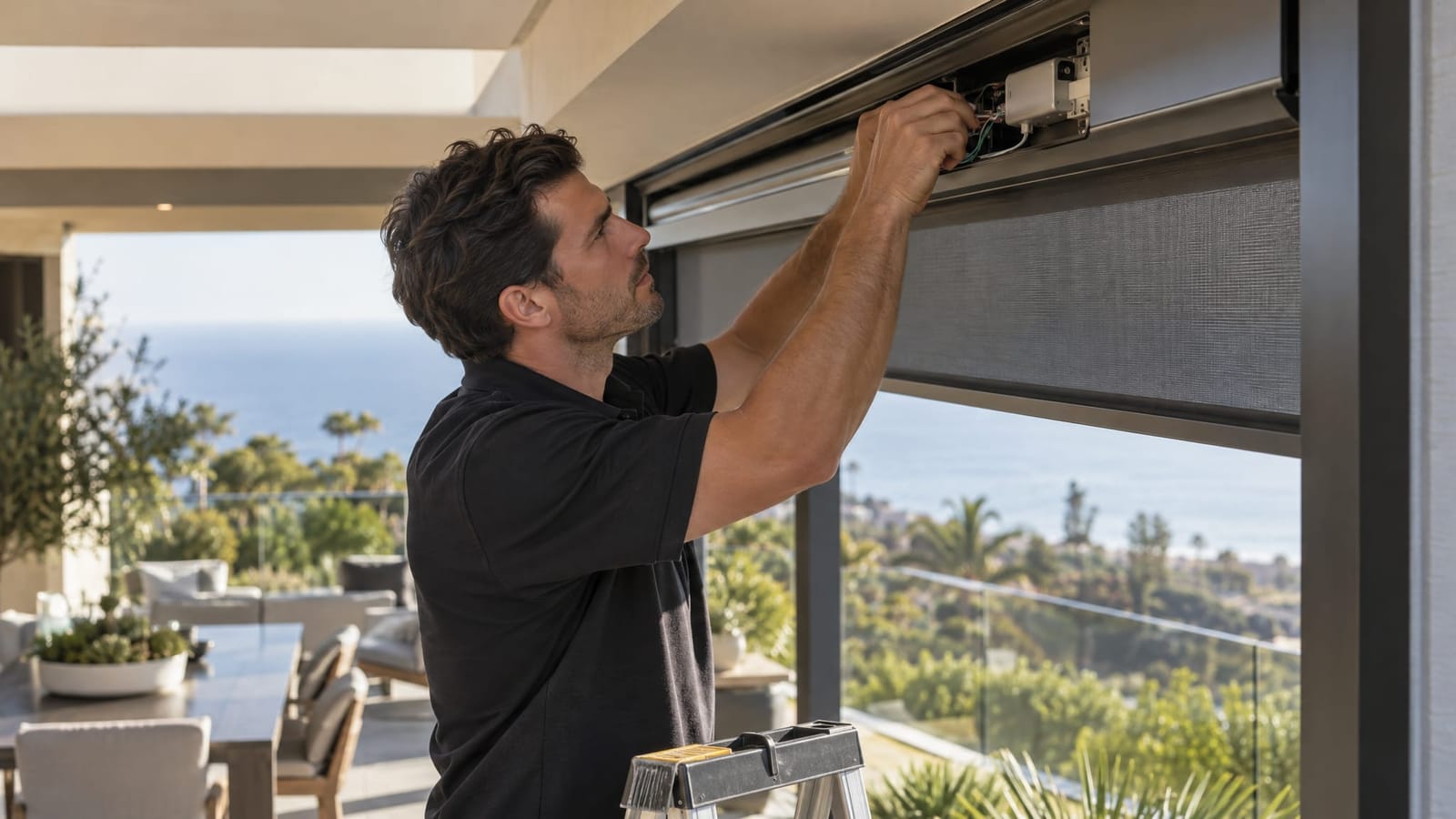
For Southern California outdoor living spaces, the right motorized shade depends on where sunlight enters. Vertical roller screens address low-angle sun along an open patio edge. Overhead pergola shades soften sunlight from above. Retractable awnings extend shade beyond a facade without creating a permanent roof.
Some terraces benefit from a combination. An overhead canopy can shade a dining table at midday, while a west-facing screen addresses late-afternoon glare. The design decisions are coverage, fabric, wind exposure, and controls, with equal attention to how the system looks when retracted.
Choose the Shade System Around the Space
Exterior roller screens for open sides
Motorized exterior roller screens descend vertically from a housing mounted above an opening. They suit covered patios, verandas, and pergola sides where sunlight enters beneath the roofline.
Side-guided designs hold the fabric within tracks; other systems use cables or different guidance arrangements. Tracks create a more defined architectural edge, so their placement deserves attention alongside columns, stonework, and sliding doors. Plan which openings provide shade and which remain clear for circulation.
Pergola shades for overhead coverage
An overhead retractable fabric shade changes how much sky and sunlight remain open above a pergola. Vertical pergola screens address the sides instead. These solve different problems, and neither automatically replaces the other.
For a lounge beneath an open pergola, overhead coverage may be the priority. For a dining area beneath a solid roof, side screening may deliver the more useful change. A fabric canopy intended for sun protection is not automatically a rain roof.
Retractable awnings for flexible projection
A retractable awning projects outward to shade a terrace, seating group, or doors. Retracting it restores the open facade and admits more daylight when shade is unnecessary.
The tradeoff is exposure: the extended assembly presents a broad surface to wind. Projection, attachment, and the manufacturer’s operating limits matter as much as fabric color. An awning is a shade solution, not a substitute for an all-weather covered room.
Read Fabric Performance Beyond “Outdoor Rated”
Outdoor suitability involves several separate characteristics. A fabric can resist fading without blocking all UV transmission, and water resistance does not make the complete installation waterproof.
- Openness and view: More open mesh generally preserves outward visibility while allowing more light through. Denser mesh provides stronger visual screening but changes the view.
- UV performance: Distinguish the fabric’s resistance to sun damage from its published UV-blocking performance. They describe different benefits.
- Weather exposure: Match the fabric and finished assembly to their intended use. Rain performance also depends on system design, slope, and drainage.
- Appearance: Compare samples against paving, upholstery, and interior finishes, both through the fabric and with light falling onto it.
Coastal exposure also makes hardware finishes and maintenance instructions important. Fabric suitability alone says little about how motors, housings, fasteners, and tracks are intended to handle the environment.
Use Wind Sensors as Protection, Not a Guarantee
On compatible systems, wind or motion sensors can trigger automatic retraction when their configured conditions are reached. That is useful protection, but a sudden gust can arrive before a shade finishes moving. Sensor placement, power, and the manufacturer’s operating instructions all matter.
A retractable awning and a guided vertical screen can have different wind limits and protective behavior. Side tracks do not turn a screen into a storm barrier.
The control plan needs to establish:
- Which conditions trigger a protective movement.
- What position the manufacturer specifies for those conditions.
- Whether the system stays retracted until conditions improve or requires a manual reset.
- What happens if power, a sensor connection, or network communication is lost.
Rain sensing is a separate consideration. It does not make a sun-shading product suitable for rain exposure.
Integrate Outdoor Shades Without Adding Daily Complexity
We offer motorized shades, lighting control, and whole-home automation at Smart Homes Innovations, with systems tailored to daily routines. For exterior equipment, the important distinction is between simple movement commands and integration that also communicates position, operating status, and protective overrides.
Before equipment selection, establish whether the proposed controller supports the functions the household will actually use. A system that accepts “up” and “down” commands does not necessarily provide reliable position feedback.
An outdoor dining scene could lower a west-facing screen and adjust patio lighting. An evening scene could leave selected screens open to preserve views. These are useful only when equipment compatibility and weather protections support the intended sequence.
Keep individual controls available for changing conditions. A guest using the terrace needs an understandable wall control or remote, not an explanation of the entire home system. Weather protection also needs priority over scheduled scenes and routine commands.
Resolve Architectural Details Before Finishes
The most discreet installation begins with the retracted system. Housing depth, mounting surfaces, cable routes, and access for maintenance affect whether the shade feels integrated or added later.
For new construction, coordinate recesses and power before ceilings and exterior finishes are completed. For an existing terrace, an exposed housing aligned with a beam can be more practical than opening finished surfaces solely to conceal it.
Allow for doors, walking routes, outdoor heaters, and furniture when defining the screen’s travel. Structural attachments and outdoor electrical work need a licensed professional’s assessment of the specific property.
Frequently Asked Questions
Do exterior screens provide privacy at night?
Not necessarily. When the terrace is brighter than the area outside, people may see through solar mesh. Privacy depends on fabric density and lighting conditions. Evaluate samples after dark rather than judging privacy from a daytime view.
Can motorized screens be added to an existing pergola?
Yes, where the structure, mounting geometry, and power arrangement suit the selected system. Decorative beams are not automatically suitable mounting points. Retrofitting also requires space for housings, guides, and future service access.
Do exterior shades replace interior window treatments?
No. Exterior shading addresses sunlight before it reaches an opening, while interior treatments serve room-specific needs such as nighttime privacy and light control. Their roles overlap, but outdoor shading alone does not resolve every interior requirement.
A More Comfortable Terrace, Thoughtfully Integrated
A successful exterior shade design follows the sun, respects the architecture, and accounts for exposure. Resolve those fundamentals first, then coordinate fabrics and controls so the outdoor space remains intuitive to use and visually composed, whether the shades are open or closed.